
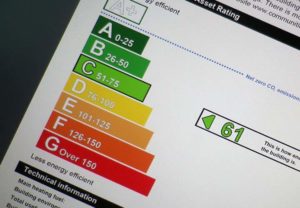
 A modern home is filled with a variety of electrical appliances: refrigerators, hair dryers, irons, and washing machines, all of which consume a significant amount of electricity. We place special demands on washing machines. They must clean our clothes perfectly, look beautiful to enhance the bathroom's decor, and, most importantly, consume minimal energy.
Manufacturers indicate energy consumption data in the equipment's data sheet and on a sticker on the back of the washing machine.
Energy efficiency class – what is it and which is better?
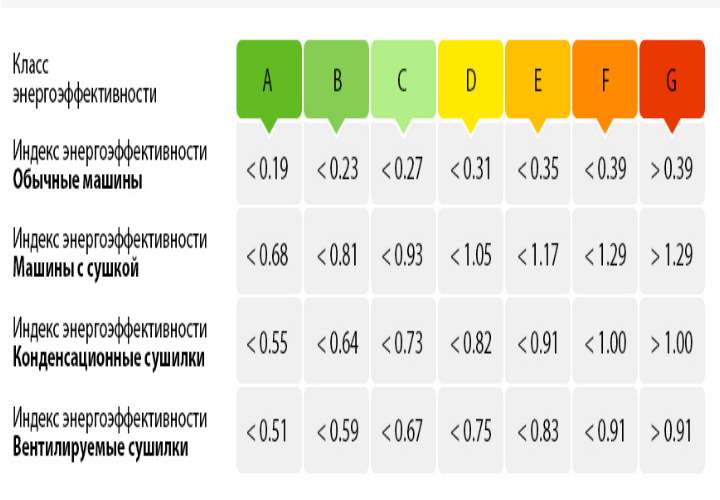
Energy efficiency class – what does it mean? Let's start with the definition of energy efficiency – it's an indicator of how efficiently electricity is consumed. However, a washing machine can't be completely energy efficient, as its design incorporates a powerful motor. Washing machine classes are designated by letters from A to G. The method for determining the class was established in 1995.
The European Community adopted Directive 92/75/EEC, requiring European appliance manufacturers to include a sticker on their products indicating the washing machine's energy efficiency class (from A to G) on a colored ruler. Under laboratory conditions, a small, soiled piece of fabric is placed in the washing machine and washed for one hour at 60 degrees Celsius.
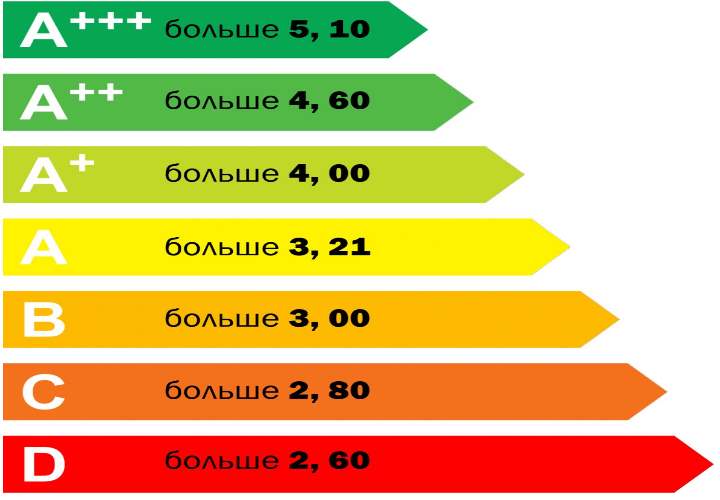
The results are compared with a standard. A class A washing machine should remove stains better than the standard, while a class B washing machine should be no worse than the standard. Currently, almost all washing machines are produced in class A. Energy efficiency class A is divided into "+," "++," and "+++." The more "+" values, the better the washing quality and the less energy consumed.
Machines with the "A" rating are marked in bright green. An "A+++" washing machine requires less than 0.13 kWh, an "A++" class machine requires 0.15 kWh per 1 kg of laundry, an "A+" class machine requires 0.17 kWh, and an "A" class machine requires between 0.17 and 0.19 kWh. "B" class machines can be identified by their pale green color on the scale. Classes C and D are shades of yellow, and E, F, and G are marked in red.
The overall energy consumption is influenced by the values of four current collectors:
- – drum drive motor (activator), the power of which is measured in watts (from 180 to 800 W);
- – Heating element – its power is much higher than the engine power and ranges from 180 to 80 watts. The heating element only operates when heating water;
- – drain pump – low-power unit (24-40 W);
- – sensors, control unit, relay, indicator lights (in total 5-10 W).
The maximum power of the washing machine reaches 4 kW.
It should be noted that energy consumption is influenced by many factors:
- – the service life of the washing machine. The older the machine, the more limescale deposits on the heating element. This increases the time it takes to heat up the water, increasing energy consumption;

-
– Load size – the energy consumed is calculated per 1 kg of laundry. The more laundry you put in the drum, the more energy your washing machine will consume;
- – the selected washing program – this refers primarily to the set wash temperature. The hotter the water, the more electricity it will require to heat it.
Technologies that make washing machines more efficient. Some manufacturers develop their own technologies to help consumers save money. Others purchase technologies from developers and incorporate them into their own products.
Here are some innovations that have made modern washing machines significantly more economical:
- - Inverter motor - thanks to innovative technology, electricity consumption has been significantly reduced. Washing machine brand LG is considered the most economical;
-
– an intelligent system – different manufacturers call it by different names, but the operating principle is the same. The ability to dose water based on the load makes the machine more energy-efficient. After all, the less water in the washing machine, the less energy it requires to heat it.
- EcoBubble is a technology developed by Samsung, which makes its machines more energy efficient. Air is added when mixing detergent and water. This increases the amount of foam, easily penetrating fabrics and effectively removing stains. This technology enables effective washing at low temperatures.


I recently saw what seemed to be a new product from Hotpoint, it has A+++, and the price is also reasonable, no more than 25 thousand rubles.