
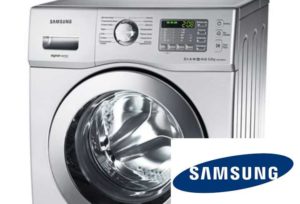
 It's worth noting that Samsung household appliances are currently quite popular not only in Russia but also around the world. Ensure stable sales growth for the company. Samsung This is possible thanks to a wide selection to suit every budget and with absolutely any technical specifications. While these appliances have long established themselves as extremely reliable in many situations, even they can occasionally malfunction, which is typical of any appliance. A common problem is when a Samsung washing machine won't turn on, something that almost any user can encounter.
There are situations where this situation indicates a serious breakdown, but often the main cause of the malfunction is the poor condition of the communications in the house.
General information
Everything can be very simple
Note! If your washing machine won't turn on at all, don't panic. There may be simple reasons for this that can be easily fixed.
Before looking for the necessary tools and disassembling the washing machine, it's essential to identify any external factors that could affect its functionality. If the machine doesn't turn on at all or makes a clicking sound, i.e., there are no indicators (the display isn't lit) and there's no response to pressing the buttons,
then it is recommended to do the following:
- It is essential to conduct a preliminary check to ensure that your home has electricity;
- Check the functionality of the socket; you can use absolutely any type of electrical appliance for this purpose;
- If you are making a connection using an extension cord, be sure to check that it is working properly;
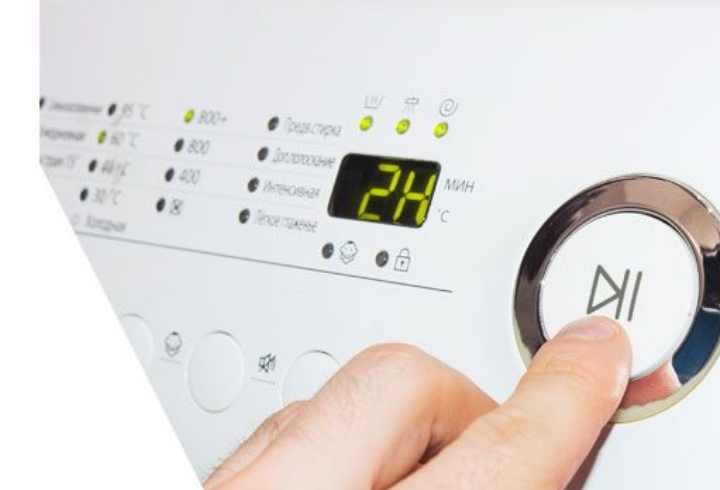
- It is necessary to check the residual current device, which may block the supply of electricity to the washing machine;
- When using a stabilizer to connect a washing machine through it, it is imperative to check it.
Please note! Your washing machine may stop working after a power surge.
Another possible cause of this error is when the washing machine is turned on, but the wash cycle itself, like any other program, fails to start. Or, the Samsung washing machine turns on and then immediately turns off. The cause of this tendency is often not inherent in the machine's design.
To check this, it is rational to perform the following fairly simple steps:
- Make sure that there is water in the water supply at this time;
- It is necessary to check not only the sewer system, but also the drain hose for possible blockage;
- Open and close the hatch again;
- It is necessary to control the entire process of laying out the linen, and also to determine its compliance with the weight.
If, after following the steps above, your washing machine still doesn't work properly, it's time to disassemble it and find the broken part. It's important to understand that this type of work is quite complex, so be sure to assess your abilities wisely and, if you lack the necessary knowledge, call a professional.
Main types of breakdowns
Before disassembling the washing machine, you need to gather the necessary tools. Repairing a washing machine requires relatively few tools: a few wrenches and screwdrivers for disassembling, and a multimeter for checking the components. Be sure to disconnect the washing machine from the power supply. If the machine is located in a small space, it may be necessary to replace the power supply to ensure proper operation.
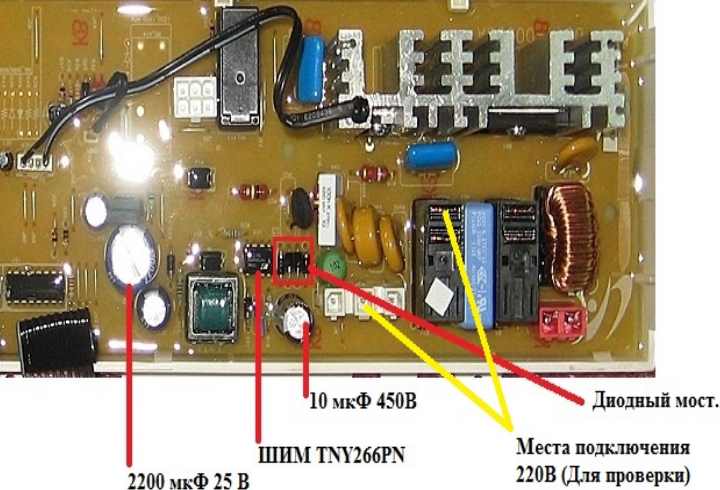
Power plug with cord
First, be sure to inspect the plug, first visually, and then test the cable. To check the cable's functionality, switch the multimeter directly to resistance measurement mode and test the cable wires one by one. If the multimeter shows an infinite reading, the cable needs to be replaced.
Power button
Some Samsung washing machine models have power supplied directly to the button. When the moving contacts fail, for example due to oxidation, this may be the reason the machine won't turn on. In this case, you need to test the button. To do this, first test it with the button off, and then with it on. If the component is broken, it won't conduct electricity when turned on and must be replaced.
Noise filter
The filter is also often the reason why the washing machine Samsung The washing machine won't turn on. The purpose of this part is to ensure that the appliance is completely protected from interference during operation. If the interference filter fails, it prevents the washing machine from turning on.
The filter's design is a barrel with five terminals. Three of its terminals are the input terminals, meaning phase, neutral, and ground. Correspondingly, two are the output terminals—phase and neutral.
To test the filter, you can apply voltage directly to its input and check for voltage at the output. It's important to understand that, despite the high speed of this test, it's quite dangerous. Therefore, it's best to perform a simple "ring test" using a multimeter.


