
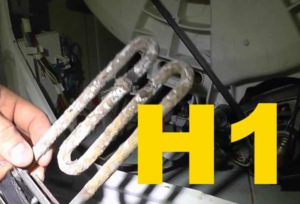
 Modern washing machines are equipped with minicomputers. They control the washing process without human intervention. If a malfunction occurs, this computer displays an error code on the display. This code can be used to determine the cause of the malfunction. Error codes vary across different washing machines. The Samsung washing machines in this review use alphanumeric codes.
Error h1 on Samsung washing machines occurs very often.
What is H1 error?
What does this error mean? Let's take a look. If your Samsung washing machine displays the H1 error code, you should immediately stop using it and resolve the error. Continued use will cause serious damage or even permanently damage the machine. Depending on the year of manufacture and the specific model, the error code looks like H1, H2, HO, HE1, HE2. Essentially, this is a single error code indicating a problem with the water heating system. Your first instinct might be to remove the heating element and inspect it. Don't rush into this.
How to fix error H1? Before attempting any washing machine repairs, you need to determine the cause of the problem and understand how your Samsung washing machine works.
The first subtlety is that the heating element in the Samsung washing machine is located not behind the wall at the back, like in many other washing machines, but in front of the drum. To access the heating element, you need to remove the front panel of the appliance, along with the control panel. A multimeter will be useful for diagnostics. But first, you need to determine the cause of the error.
Important! Before opening the machine, remember to unplug it.
Details of the question
Causes of the H1 error
The H1 error on a Samsung washing machine may appear in the following cases:
 – if the water is not heated before washing;
– if the water temperature becomes too high during the washing process;
– if the steam starts to overheat while drying clothes.
There are several causes for these processes. The most common ones are:
– the temperature sensor is broken;
– shorted the wires in the heating element;
– the heating element itself broke;
– all elements are operational, but the device’s overheating protection was activated by mistake.
Let's look at each reason in more detail.
Short circuit (break) in the wires or problems with the heating element
Once you've gained access to the heating element, you need to check its functionality. Don't forget to remove the protective cover on the heating element. It's located in a recess directly under the hatch. First, conduct a visual inspection.
1) There are two contacts under the protective cover. Wires are attached to them. Carefully inspect these wires and contacts. They may have oxidized, causing the contact to be lost. Check the wire connections. They should not be loose.
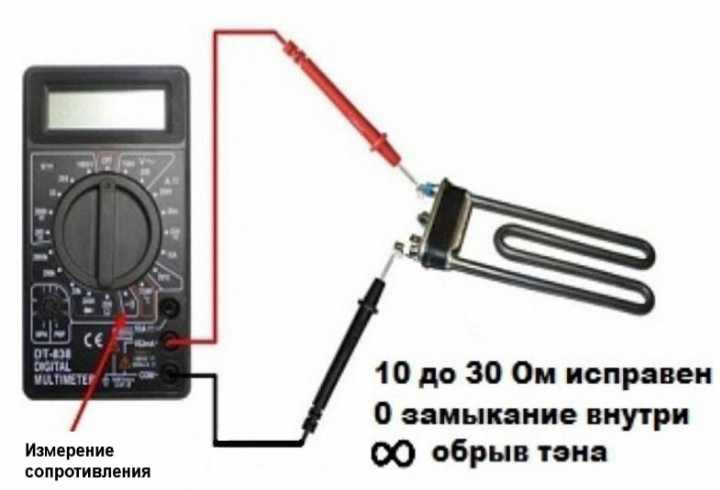
2) The heating element itself could have been damaged by a power surge. To check this, use a multimeter. But first, disconnect the wires from the heating element. The voltage will be measured in ohms. The normal value for the heater is 27-30 ohms. Any deviation indicates a problem. A reading of 0 indicates an internal short circuit. If the infinity sign appears, there's an open circuit. If you see a reading of 1, you can be sure the heating element has burned out.
3) Measure the resistance of the wires coming out of the washing machine. If the readings are roughly the same, there's no problem with the power supply. If the readings are significant, you need to find the damaged wire. A broken wire will need to be replaced.
This operation is not complicated and will not cause any problems.
Here's how to replace the heating element, we'll describe in more detail:
1) There's a nut between the contacts we checked at the beginning. It needs to be unscrewed. Now the heating element can be removed.
2) We take hold of the contacts and begin to pull it towards ourselves, while slightly swinging it from side to side.
3) After removing the old heating element, you'll see a hole leading into the tank. The tank itself needs to be cleaned of scale and other debris. An old toothbrush works well for this task. Insert it into the hole and clean the tank.
4) We clean the contacts with a special agent to prevent their oxidation.
5) Apply soap, for example, to the edges of the hole to reduce resistance. Carefully insert the new, working heating element into this hole. Be mindful of the heating element's rubber seal. It must not be moved or damaged.
6) Next, we reconnect the wires, put on the protective cover and put everything back together.
7) After running a test wash, we make sure that the machine is working properly.
Problems with the temperature sensor
If the heating element and wires are intact and there is no damage, but the washing machine still doesn't work, the problem may lie with the temperature sensor. Samsung washing machines use thermistors as these sensors.
The thermistor is located directly on the heating element.
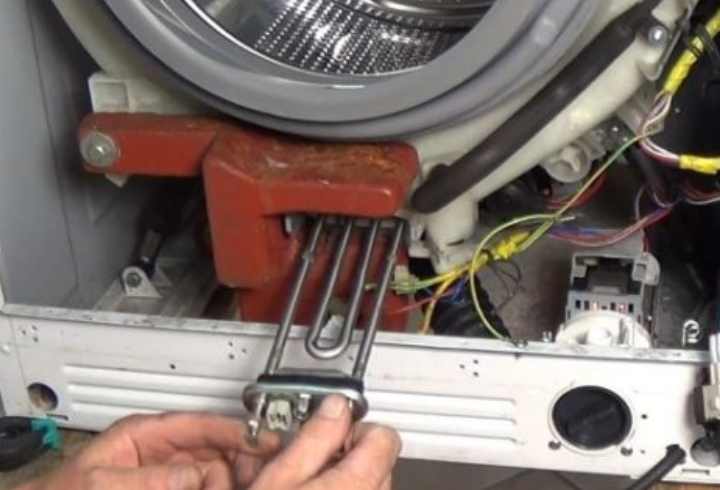
1) First, remove the cover at the front of the machine and the heating element protection cover.
2) Right on the heating element itself you will see a black (sometimes grey) plastic element.
3) Check the resistance with a multimeter. Its normal value is 35 kOhm. If there is a deviation from this value, the sensor will need to be replaced.
4) Replacing the temperature sensor is easy. Disconnect all contacts and carefully remove it. You can use a flat-head screwdriver to pry it out. Then install the new element in its place. It's important to remember which contacts were connected to which location and not mix them up during installation.
Overheat protection has been activated
The overheat protection in Samsung washing machines is fairly straightforward. Inside the heating element is a coil connected to its contacts by a fusible link. If the coil overheats, this fuse melts, breaking the circuit, but the coil remains intact. All that's left to do is replace the sensor. But there's a problem: Not all machines have this feature.
There are two options:
1) The sensor is inseparable from the heating element. The entire heating element will need to be replaced, as described above.
2) The heating element's safety elements are made of ceramic. If they overheat, they simply break off, which also interrupts the circuit.
We proceed as follows:
– we find plastic rivets on the base of the heating element and break them off;
– the ceramic fuse will fall off and needs to be cut off, for example with a hacksaw, and put back in place;
– we glue the damaged heating element housing with heat-resistant glue;
– we check the resistance with the device and install all the elements in their places.
– we check the serviceability of the washing machine.
Preventing the H1 error on washing machines
We've figured out how to fix the H1 error on Samsung washing machines. But how can you avoid it?
1) Monitor your water quality. Poor water contains impurities that can form scale on the heating element. Install a water filter. This will eliminate this problem.
2) When repairing your washing machine, use high-quality parts. This will extend its lifespan and prevent frequent breakdowns.
3) Don't neglect the operating conditions of your washing machine. These are listed in its instructions.
4) Regularly descale the inside of your washing machine. There are special products for this purpose. This will extend its lifespan.
If your Samsung device displays the H1 error, you can fix it yourself. The key is to listen to the advice and follow the instructions. However, incompetent intervention will cause more problems than it solves. It's up to you to decide whether to do it yourself or call in a professional.


Error H1 appears after 15 minutes of operation. The heating element and temperature sensor are working properly. The heater relay is working properly. Could the Darlington matrix that activates the heater relay be faulty? Wash programs at 30 and 40 degrees Celsius run without errors, but starting at 60 degrees Celsius, the machine stops after 15 minutes. What is this? A firmware error?