
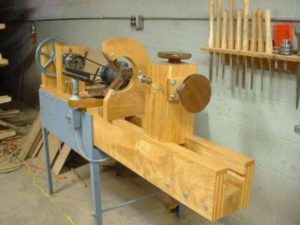
 A professional milling machine is quite expensive, but what if you want to try your hand at wood carving or you only need the machine rarely and for very minor jobs?
Try making a milling machine yourself from an old washing machine.
General information
Pros and cons of a homemade machine
The only downsides to this device are that it doesn't have all the capabilities of an expensive machine, but it can easily handle simple projects, and with a little imagination, you can achieve incredible beauty with a homemade machine. It's also less powerful than a professional machine.
But such a device also has its advantages: a homemade machine is much more mobile, it is convenient to store at home and carry in your hands, unlike a professional machine.
The simplicity of the design is also a plus: even a novice can assemble the milling machine themselves, and replacing parts in case of breakdown is also very easy. Furthermore, it's assembled from readily available parts, meaning replacement won't break the bank.
Types of washing machine motors
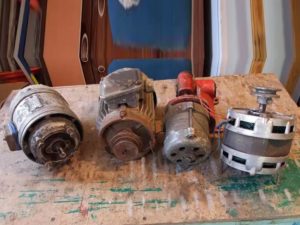 Before you learn how to build a machine yourself, you need to figure out what kind of motor you have. There are several types.
Asynchronous: There are two types: two-phase and three-phase, respectively. The former were used in older Soviet washing machines, while the latter are installed in modern models.
Commutator: A motor in which the speed can be controlled, often quite compact in size.
And the last motors that are often installed in Korean washing machines are direct drive motors.
Important:
Before you begin building your milling machine, remember safety precautions. Also, clear a clear area to avoid hitting anything while you're working.
Details
Materials for the machine
Before starting assembly, you need to prepare all materials.
– A drill, electrical tape, screwdrivers and pliers, you will also need metal scissors.
– An angle grinder or hacksaw for metal, measuring tape, foam rubber or other dense material to protect the engine from debris.
– A pin to connect the cutter chucks.
– Iron corners and screws for fastening.
– The motor, the most important part, is removed from the old washing machine and cleaned.
- A board or a thick sheet of plywood.
- Two metal tubes.
– Two shock absorber springs from a car and a rubber swivel wheel.
- Something that will serve as an on/off button for you.
– An optional part, but convenient to use, is a speed controller; for example, you can take it from an old drill.
Assembly instructions
Let's start assembling a milling machine with our own hands.
Step one:
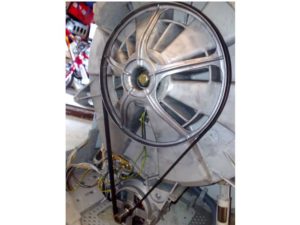 Clean the washing machine's motor of dirt and remove any deposits. It's also important to check its operation by plugging it in. Listen carefully and determine if there are any unusual noises, such as clicking or cracking, as this type of motor is unsuitable. A properly functioning motor that rotates smoothly and without any unusual noise is essential.
Important: After checking, be sure to disconnect the motor from the power supply; you will not need a working motor during assembly.
Step two:
We measure the motor's dimensions to determine the required table size. The table should be three times larger than the motor, and the motor itself should be positioned 7-8 centimeters above the floor. We cut the wooden frame to the required size.
Step three:
In the table top we make a hole for the motor play, and in the bottom a hole for installing the nut.
Step four:
Assembling the finished table using screws and brackets. This is how we made a router table ourselves.
Step five:
We proceed to the assembly of the machine itself, attaching the collet to the motor shaft.
Step six:
We take the previously prepared tubes and use scissors to make special mounts. Using a drill, we make holes in the mounts so they can be easily secured to the table and motor.
Step seven:
We attach tubes to the back of the table to ensure maximum stability. Now the tubes need to be carefully screwed to the washing machine motor.
Step eight:
We attach a nut to the bottom of the machine.
Step nine:
To securely fasten the motor, screw the stud into the nut so that the threaded end fits tightly against the motor.
Step ten:
We add springs so that the engine can be freely adjusted in height, and we can also add a steering wheel if desired.
Step Eleven:
It's time for wiring, we install and connect to the power supply sensor, attach the start button and, if desired, the speed controller.
Important: After installing the wiring, check that all cables are insulated and not tangled.
Step twelve:
We install foam rubber or other protection to prevent clogging.
The last step
That's it, all that's left is to test your homemade wood milling machine for functionality and use it.


