
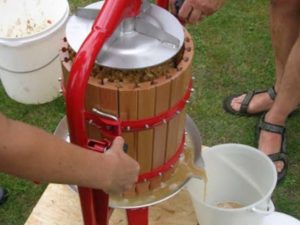
 If you're the proud owner of your own garden and have a good harvest of apples or other fruits, don't rush to give them away to your neighbors, lest they spoil. You can build your own apple press from a washing machine and other household items. This homemade juicer can produce 20 liters of juice in an hour—a task that an electric juicer can't match.
A manual press is also useful for winemakers, as it eliminates the need for expensive equipment. It handles large volumes and preserves all the beneficial properties of the juice.
General information
These homemade juicers were made back in the Soviet era from old washing machines, but even in the 21st century, you can use a broken modern washing machine. You can customize a convenient apple loading compartment, more capacious than store-bought units, for greater productivity.
Note: When using a homemade press, fruits and vegetables must be thoroughly washed and chopped.
Note: Use a cloth strainer to extract the juice if you want the juice to be pulp-free and clear. Let the juice sit.
Washing machines use tanks made of stainless steel, which does not oxidize or react with juice, and is ideal for working with tartaric acids.
Important: A press differs from a juicer in that it doesn't require electricity, doesn't heat up, and preserves the original flavor of fruits and berries. This is especially important for winemakers!
To understand the assembly process, you will need a visual drawing.
Details
What do you need to get started?
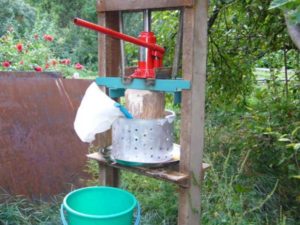 1) Pen
2) main screw of the press
3) frame
4) metal disk
5) washing machine drum
6) outer casing
7) pallet
As can be seen in the drawing, this design does not use a motor, meaning that the press, unlike a juicer, can be used without electricity.
So, let's take a step-by-step look at the press assembly diagram.
1) You'll need to remove the drum from your washing machine, descale it, and thoroughly clean it. Limescale is easily removed using citric acid and boiling water.
2) Weld a frame from a metal angle and make a hole in the top for a nut and screw. Weld the nut into this hole.
3) Make a tray from a metal sheet, bending it at the edges to allow the juice to drain.
4) Select or cut a metal circle according to the diameter of the tank and weld it to the screw.
5) Weld the handle horizontally to the screw at the top.
The press works like this: You turn the screw, and a metal disk descends and crushes the fruit. The juice passes through the holes in the tank and pours into a tray, from which it flows into a container underneath.
A more labor-intensive process is to independently convert an electric juicer from an old washing machine.
Unlike a press, this juicer offers much greater productivity, and you don't need to be constantly near the machine. Furthermore, apples and other fruits and vegetables only need to be washed, without any additional chopping.
 Remove the tank from the old machine and thoroughly clean it to remove any limescale deposits. Citric acid is a good choice. Remove all unnecessary parts, including the heating element.
- All holes in the tank should be welded shut using tin sheets, leaving only the holes to which the drain for the finished juice will be attached.
- Make a grater from a round sheet of iron; it should be fifteen to twenty centimeters smaller than the bottom diameter. Drill five-millimeter holes and make them convex, like a regular grater. Place a metal circle on a rubber gasket to reinforce the structure.
- Attach the homemade grater, disc, and rubber gasket to the bottom of the centrifuge using bolts. Tighten the nuts securely from the outside; rotation creates vibration, so be careful not to loosen them.
- Attach the drive with a belt and attach a motor with a power of at least 1500 rpm.
- The centrifuge's holes are slightly larger than necessary, and a lot of pulp will end up in the juice. To prevent this, you should additionally install a fine mesh screen around the drum. Or use a damp cloth as a filter, also placing it around the inside of the drum.
- A tube for loading apples should be attached above the grater. Its height from the grater should be 4 cm, and its diameter should be 10-15 cm. It should be positioned closer to the edge to facilitate the removal of apple residue.
- This entire apparatus must be installed on a metal structure welded from corners for stability.
- To drain the juice, you need to attach a tube to the tank.
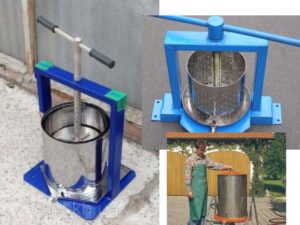
Please note: a homemade juicer is best for firm fruits and vegetables, such as apples, pears, carrots, and pumpkins. For soft berries, including grapes, a press is better.
Washing machines, after they break down, can be converted into many useful household appliances: crushers, wringers, and mixers. All it takes is a little ingenuity and patience!