
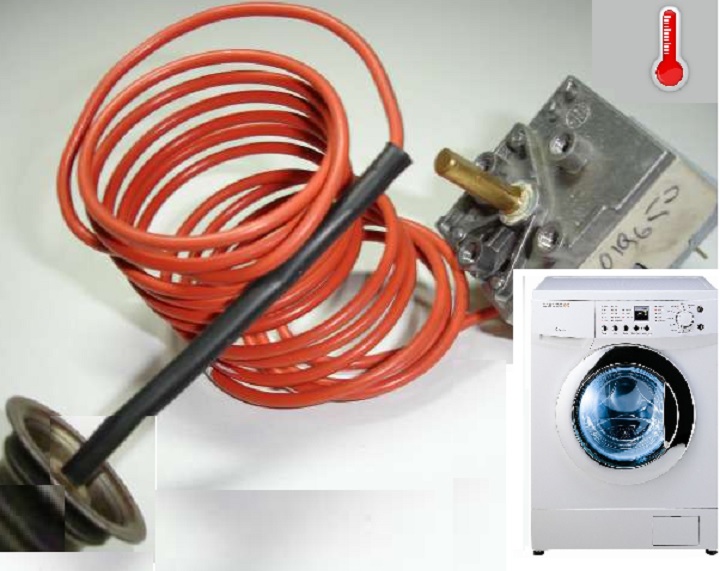
 The temperature sensor is a part inside the machine that is responsible for the water temperature and the operation of the heating element.
If overheating occurs or the water does not heat up at all, the thermostat will be to blame, as it sends readings to the automatic control system to shut off the heating in a timely manner.
In this article, we will consider the problems associated with the temperature control sensor.
Types of thermostats
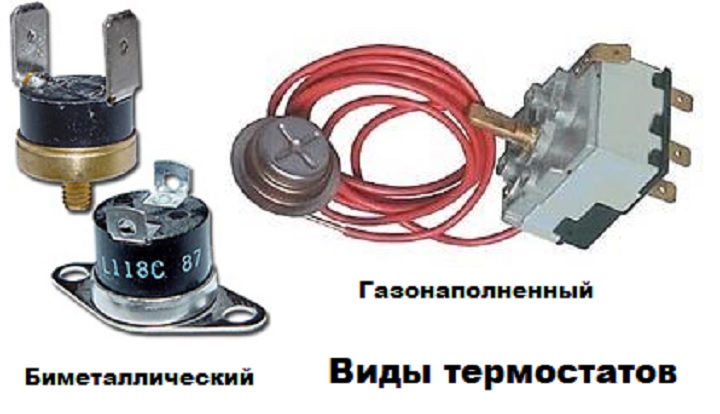 There are many models of washing machines and not all of them have the same sensor design.
They are divided into electromechanical, which are subdivided into:
- bimetallic;
- gas-filled.
There are thermostats with independent decision-making. Others are electronic—these are modern thermostats called thermistors.
Electromechanical sensors
Their operation consists of breaking the electrical circuit when a set temperature is reached.
Gas-filled
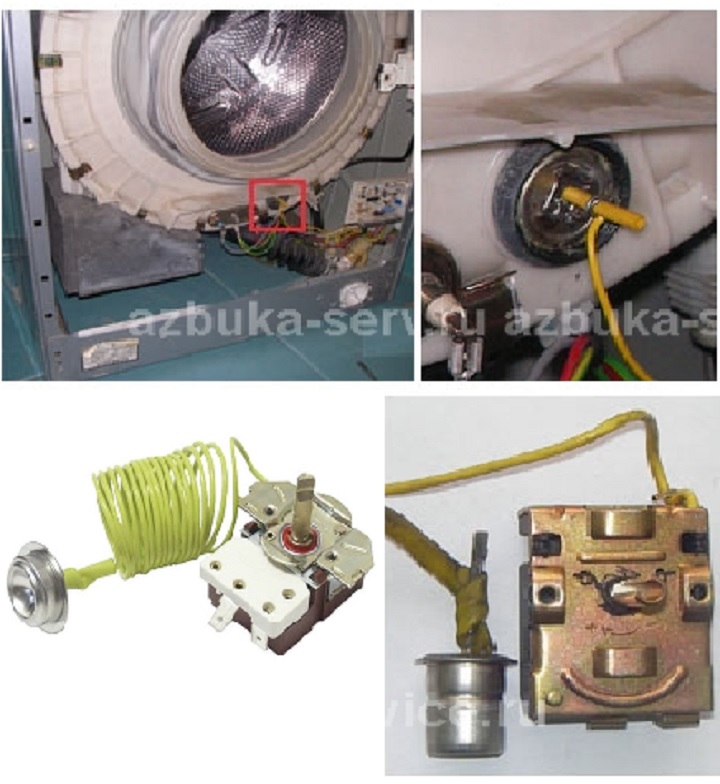 This sensor is divided into two halves. The first is shaped like a metal tablet, up to 30 mm in size and 30 mm in height.
This part is located on the inside of the machine tank and is in direct contact with water.
The other part of it looks like a copper tube that connects to the temperature controller that we see on the control panel.
This thermostat is filled with freon. As the water temperature changes, it expands or contracts, causing the heating element contacts to close or open.
Bimetallic
It also looks like a tablet of the same size, approximately 30 mm, only the height is no more than 10 mm.
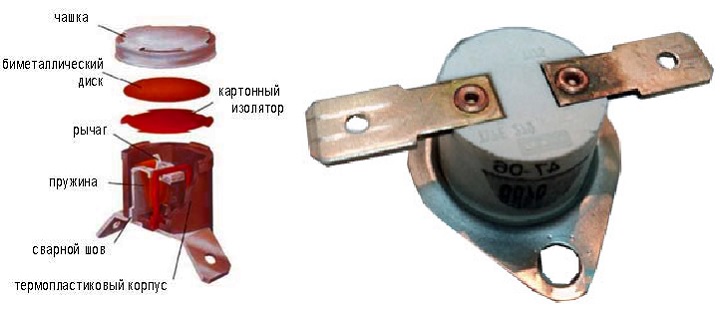 It got its name from the bimetallic plate located inside.
When the water heats up to the required temperature, the metal plate bends and this allows the contacts to close, stopping the heating.
Electronic sensor
We'll talk about the thermistor. It's installed in almost all modern washing machines and dishwashers.
It is a long (30 mm) metal cylinder or rod with a diameter of 10 mm.
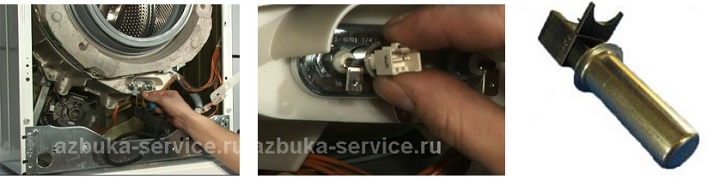
It is located directly on the heating element. The thermistor detects changes in resistance as the water heats up to the set temperature and, once the desired temperature is reached, signals the heating process to stop.
How to check the washing machine temperature sensor?
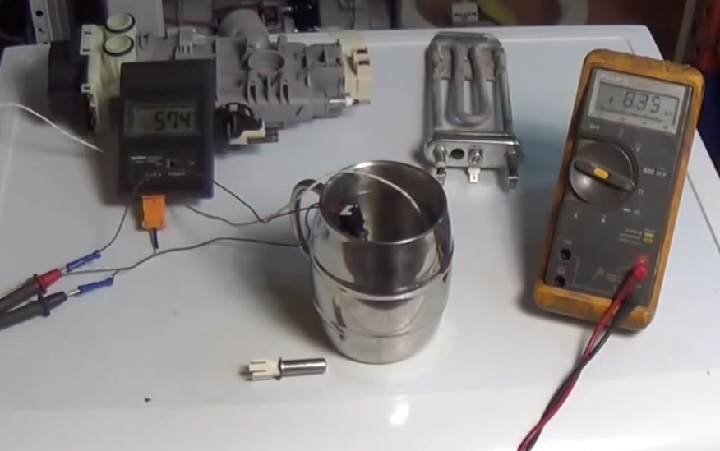 To make sure that a part is faulty, you will have to remove it.
Often, the electronic thermistor is located inside the heating element that sits at the bottom of the washing machine.
Checking your washing machine's temperature sensor isn't difficult. First, you need to remove it, and to do so, you'll need to:
- remove the back cover;
- disconnect the wires from the sensor;
- do not completely unscrew the screw that holds the heating element;
- get the thermistor.
A multimeter can tell you whether a part is working or not. If it's already set to measure resistance, all you have to do is connect the probes to the sensor contacts.
Multimeter readings
The multimeter should show a resistance of 6000 ohms if the temperature is 20 degrees.
Although the multimeter readings are quite approximate, you need to take your washing machine model into account:
- U Zanussi, Electroulux at a water temperature of 30 degrees, the resistance is approximately 17 kOhm.
- Washing machine temperature sensor Ardo will show 5.8 kOhm in normal mode.
- U Candy under the same condition 27 kOhm.
Now, dip the thermistor in water at 50 degrees Celsius and check. The resistance should drop to 1350 ohms (depending on the model).
To find out exactly what the indicators should be, you need to look at the machine description or the manufacturer's website.
If the thermistor is faulty, it cannot be repaired. You'll have to buy and replace the washing machine's temperature sensor.
Checking the gas-filled sensor
The gas-filled sensor is a little more difficult to reach.
You'll need to remove the back cover and front control panel. On the control panel, you'll need to unscrew the outer part of the sensor. On the back, you should see a terminal with wires.
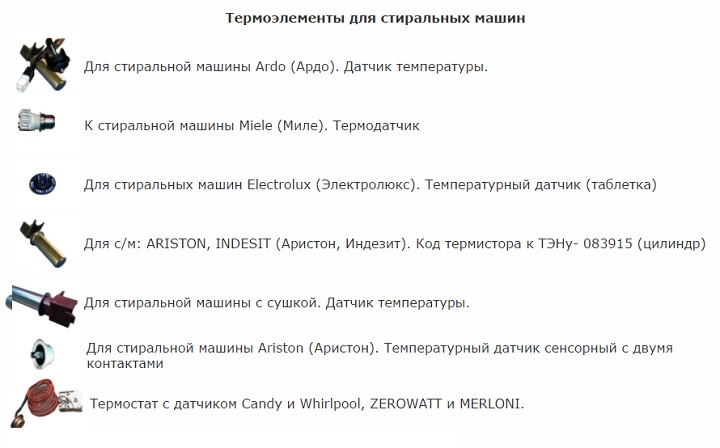 It is very important to avoid damaging the copper tube, so you will have to remove the rubber insulation very carefully.
You can use an awl to pry the seal around the tube and remove it. To release the sensor from its groove, apply slight pressure, pull it out, and unhook the wires.
A common failure for such a sensor is a problem with the copper tube from which freon comes out and replacing the temperature sensor in the washing machine.
Checking the bimetallic sensor
The bimetallic sensor is located in the same place as the gas-filled one and is removed in the same way.
It's tested with a multimeter and then heated in hot water, just like with a thermistor. Typically, failure of this sensor is due to the plate, its wear, or mechanical damage. If faulty, it's replaced with a new one.
How do you know if the sensor is broken?
There are external signs that allow you to confidently determine that the problem is with the sensor. These include:
- Even at a low temperature setting, the machine heats water to boiling point.
- The machine body heats up during operation, and steam is visible from the hatch.
Urgent repairs or replacement will be required, otherwise the heating element will fail, or more specifically, burn out, which will hit your pocket hard.


I recently bought a used ARDO AE810 washing machine. The owner didn't warn me about the problem, only saying the heating element wasn't working. I checked it at home and noticed water was leaking from below. A closer inspection revealed the bottom of the tank had melted and was leaking. The heating element itself was burned out. The inlet valve and drain pump were working properly. The thermistor, however, was intriguing. Even without the signal wires, current was still flowing to the heating element, meaning the contacts were closed. I'd like to understand how this system works. How did this all happen? How did the heating element turn on without water? I found the following markings on the sensor: 0238 526022001 T856-T120K 1641 250*C No. 92. Which of these markings indicates the sensor model? There are 4 contacts. Current comes to one of them, and from the other one it goes to the heating element. And two red wires go to the other two.