
Icons and symbols are placed on clothing to ensure that your underwear and favorite clothes retain their color, quality, and original shape for as long as possible. To ensure that your underwear and favorite clothes retain their original shape, follow certain washing and care recommendations.
Content
What do the symbols on clothing mean?
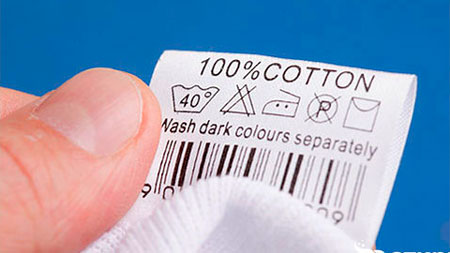 High-quality clothing and underwear always have a manufacturer's label, which will indicate the composition and recommended care procedures.
We will present some of them below and tell you about them in more detail.
Full explanation of symbols
| fabrics | Fabric care |
| Natural materials | |
| Cotton | It can be washed at any temperature, both in a washing machine and by hand using various detergents. Cotton items may shrink by 3-5%. |
| Wool | Hand or machine washing is recommended using a wool cycle at a temperature no higher than 30 degrees Celsius. Use only detergents suitable for wool. Avoid excessive wringing or spinning after washing. Dry the garment gently on a towel until the moisture is completely removed. |
| Silk | Requires gentle handling only. Hand wash with special detergents for silk and wool is recommended, at a temperature not exceeding 30 degrees Celsius. Does not tolerate high temperatures. Do not soak. Colored items should be washed separately. |
| Artificial materials | |||
| Viscose, modal, rayon | Washing at low temperatures is recommended. Hand washing is preferred. Shrinkage may vary by 4-8%. Use fabric softeners when washing. | ||
| Synthetic materials | |||
| Polyester, elastane, polyamide, lycra, tactel, dacron | Machine wash at 40 degrees Celsius or lower is recommended. Do not iron (otherwise, the fabric may melt). | ||
This applies to all materials:
 Try to minimize the use of bleaching agents unless stated on the label of your product.
- Use gentle detergents (powders or liquid gels).
- Incorrect powder dosage or gel may damage your clothing. Recommendations for the amount of product to use are printed on the product packaging.
- When machine washing, place underwear in special bags.
- Do not soak colored or printed fabrics under any circumstances.
- Do not tumble dry.
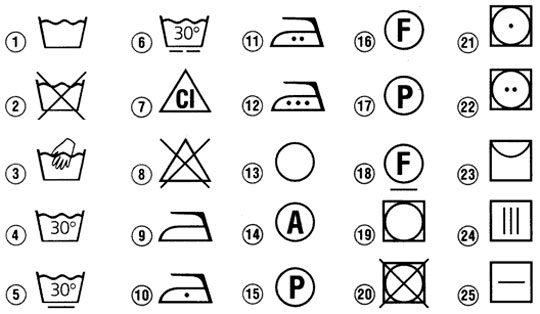
- Before washing, carefully read the care instructions on your garment's label. The most common symbols and their meanings are provided at the end of this article.
- Try to sort your laundry by wash type. Wash new and brightly colored items separately during the first wash. Divide brightly colored and darkly colored items into two separate washes.
- If labels contain symbols and icon delicate wash, try reducing the amount of laundry you're washing by half. This will help prevent excessive wrinkling. It's best to wash synthetic and synthetic-blend items separately from natural fabrics.
- Dark fabrics contain a significant amount of color pigments. This excess should be removed during the initial hand wash.

| Icon | Decoding |
 |
Washing is allowed |
 |
Cannot be washed! |
 |
Only hand washing is allowed at a temperature not exceeding 30 degrees, do not wring or rub |
 |
Machine or hand wash at temperatures not exceeding those indicated. |
 |
If the water cup is underlined with one or two lines, it means special precautions should be taken. Hand or machine wash. Carefully adhere to the temperature indicated on the label, do not subject to vigorous mechanical treatment, rinse with cold water, and use the lowest spin cycle setting when spinning. |
 |
An extremely delicate wash with plenty of water, minimal mechanical processing, and a quick rinse at low speeds. |
 |
Washing using boiling |
 |
You can bleach the product |
 |
Do not bleach or use chlorine-containing products or powders with bleaching particles. |
 |
Washing with chlorine-based bleaches is permitted. Use only in cold water, and ensure the detergent is completely dissolved. |
 |
Do not use any products containing chlorine. |
 |
Ironing is allowed |
 |
Do not iron |
 |
Iron at a maximum temperature of 100 degrees Celsius. Suitable for wool and fibers blended with viscose and polyester; use a damp cloth. |
 |
Iron at a maximum temperature of 150 degrees Celsius. Suitable for wool and viscose-blend fibers. Use of a damp cloth is mandatory. |
 |
Iron at a maximum temperature of 200 degrees Celsius. Suitable for cotton and linen; you can slightly dampen the item when ironing. |
 |
Dry cleaning only |
 |
Do not chemically clean under any circumstances. |
 |
Dry cleaning with various solvents is allowed. |
 |
Dry clean only with carbon and trifluorotrichloromethane |
 |
Dry cleaning only with carbon, ethylene chlorine and monofluorotrichloromethane with a small amount of water and control of the mechanical nature and temperature of drying |
 |
Machine tumble dry and dry in a dryer |
 |
Do not spin dry or tumble dry |
 |
Dry at warm temperatures |
 |
Dry at hot temperatures |
 |
After unscrewing, dry in a vertical position. |
 |
Dry without spinning |
 |
Drying on a hanger |
 |
Drying on horizontal surfaces |