
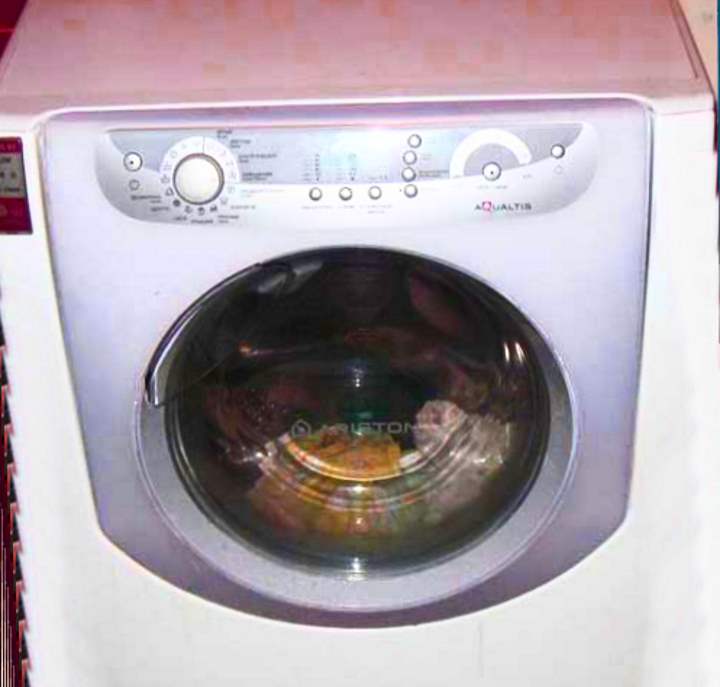
 There are a huge number of washing machine models on the modern home appliance market. They all vary in power, controls, capacity, color, and so on.
But each of them can be classified into one of two existing categories: activator or drum.
Of course, there are many more drum models and their popularity is enviable because they are more economical and gentle. But their downside is that they are capricious and break down more often.
What are the possible breakdowns?
Common breakdowns include:
- water leak from under the bottom;
- the machine freezes;
- loud noise and vibration;
- water intake without drainage;
- The washing machine fills with water but does not wash.
Let's dwell on the last point.
The machine fills with water but doesn't wash.
The machine is turned on, the laundry is loaded, the wash cycle is running, and the water has even filled, but here's the problem... the wash cycle has stopped and the machine isn't washing. It's as if it's frozen! The drum isn't spinning, and the machine isn't responding to anything.
What happened? What could have happened:
- Complete stop of the drum.
- Breaking heating element.
- The engine failed.
- The bearings failed.
- The belt came off.
- The control module is faulty.
Let's take a closer look at each reason.
Drum lock
The drum cannot rotate if a small foreign object gets between it and the tank.
This is a mechanical failure and if you remove the interfering object, the problem will be solved.
Heating element failure
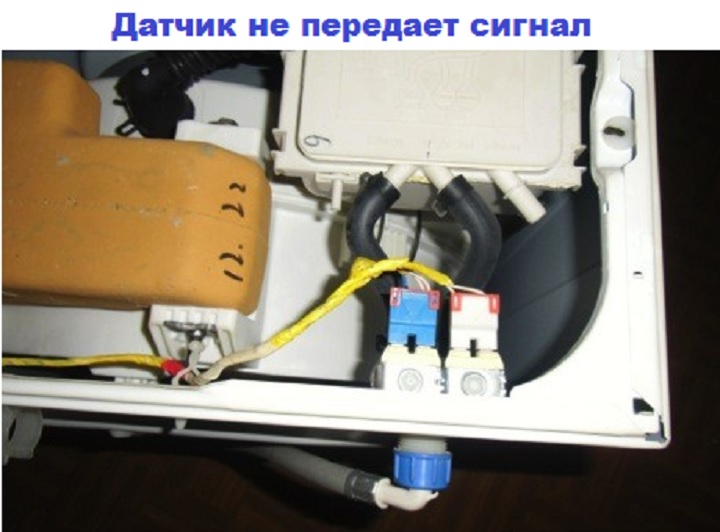 It may sound strange, but yes, there are problems with heating element affect the performance of the drum and a situation arises where the machine fills with water but does not wash.
The engine does not receive a command from the sensor to start working. In turn, the sensor cannot record the required heating temperature.
This means the motor won't turn on, and the drum won't either. To check and inspect the heating element, you'll need to remove the rear or front cover of the machine, depending on the model.
The heating element is located at the bottom of the tank. To access it, remove the wires and unscrew the nut in the middle of the element. If there are black spots on it, it's likely damaged and needs to be replaced.
If there are no visible faults, diagnostics with a tester will be requiredIf the heating element is in good working order, the resistance should be between 20 and 40 ohms; otherwise, it should be less than 20 ohms. The heating element must be reinstalled carefully.
It's important to ensure proper sealing with the rubber seal on the heating element housing. If the element is slightly higher than the correct location, the drum will catch on it.
Washing machine motor malfunction
Most often, only the brushes need to be replaced, not the entire motor component. To replace the brushes, you'll need to remove the engine, along with all the sensors and the belt. Using a screwdriver, remove the terminal on the brush. To remove the brush, insert a tab into the hole, bend it back, and pull it out.
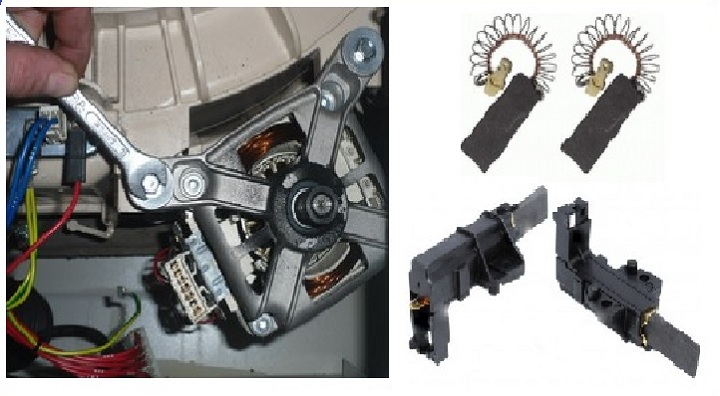 The same steps will help you remove the other brush. Insert the new brush into the brush holder, press it with the spring, and secure it. That's it. Unless, of course, you're dealing with an asynchronous motor, which doesn't have brushes.
In such engines, the starting condensate capacity is basically lost and it does not have enough current to start, naturally, there can be no talk of revolutions.
In this case, replacing the capacitor will solve the problem. Less frequently, rewinding is necessary due to a burnt-out motor. There are situations where the motor fails to start due to overheating, causing the machine to flood and not wash. This is usually caused by running several washes in a row.
To solve the problem, just give the machine time to cool down.
Bearing failure
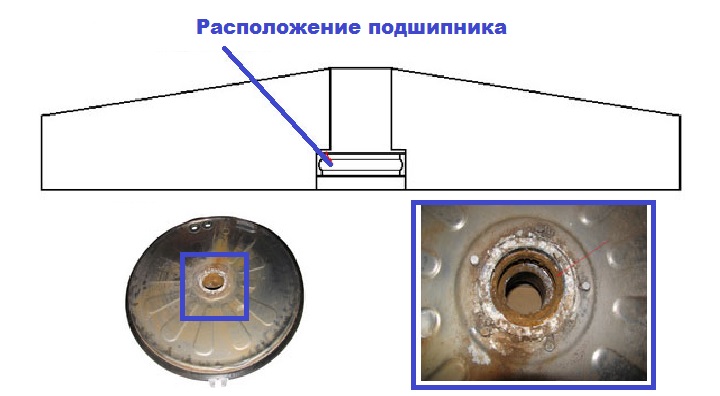 To bearings are difficult to reachThey are located in the very center of the washing machine's drum. They enable the drum to rotate.
If the bearings have failed, the machine will notify you with a clear creaking and noise during operation, and will also knock.
Failure to replace it in a timely manner can lead to more serious repairs, as a broken bearing can break the belt and damage the drum.
The drive belt is not working
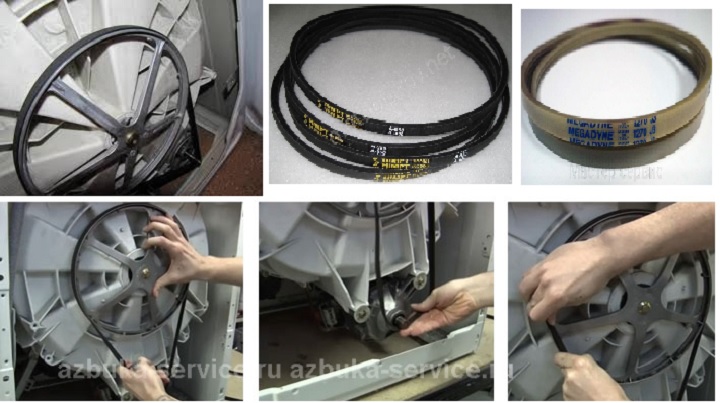 Washing machine it collects water but doesn't wash – you can safely start diagnostics with the belt, unless of course the machine is a direct drive.
A common cause of belt problems is regularly overloading the machine with laundry. Constant stress on the drum axle causes it to become loose and wears the belt, which can deform or even break the part.
Sometimes the belt falls off during transport. You'll need to disassemble the washing machine and check for any problems. The belt is located behind the rear door for front-loading machines and behind the side door for top-loading machines. If the belt is intact and simply fell off the pulley, this isn't a problem. Otherwise, the broken belt will need to be replaced with a new one.
Installing or replacing the belt requires simple steps. Remove it from the car and inspect it for any defects. To install it, first slide it onto the engine, then pull it upward with one hand, and slide it onto the pulley with the other. To secure the belt, turn the pulley counterclockwise and slide the belt onto it.
Control module failure
In this case, you can’t do without the help of a specialist, because the problem is electrical.
The module will need diagnostics and testing on a special stand, as it's difficult to visually determine what's burned out on the board if there are no black marks on components or tracks. Even if there are, professional soldering will be required. This is painstaking work. Without experience and skills, there's a high chance you'll end up buying a new board and replacing it with the old one.
How to identify the problem yourself
There are simple and uncomplicated issues that you can identify and try to fix yourself. You can do it yourself:
 If you have a tester, you can check the heating element and the motor. If strong sparking is visually visible, you will need replacing brushesWhen purchasing them, you need to consider the type of motor your washing machine uses.
- Emergency drain the water from the machine using a special valve or hose if the washing machine has filled with water but is not washing.
- Visually inspect the tub and drum for any foreign objects lodged between the components. This will require removing the side panels of the washing machine. If an obstructing object is found, simply remove it.
- You can check the drive belt yourself. If it's simply slipped, reinstall it so that there's an extra tooth. If it's broken, replace it with a new one.
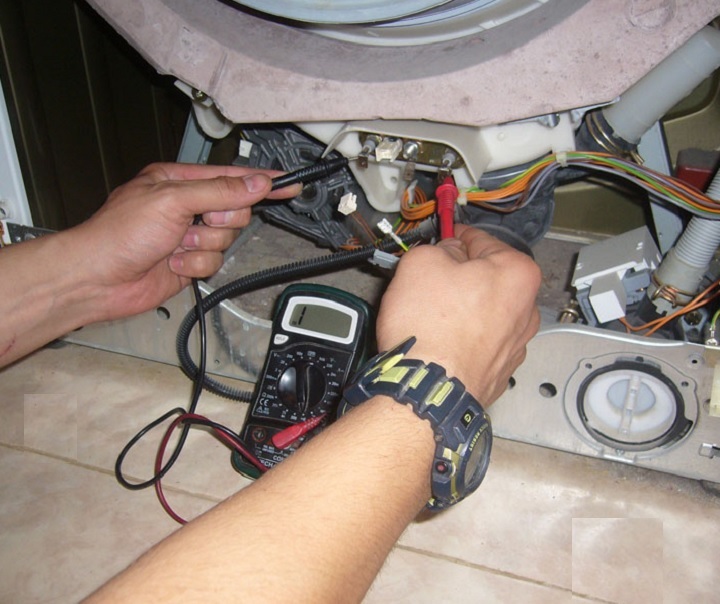
If you don’t know what’s wrong with your car or why it’s not working, it’s best to contact a service center.
To prevent breakdowns of this kind, all you need to do is:
- do not overload the drum with laundry,
- install surge protection,
- Use a filter because many people know what kind of water is best for washing and what consequences ignoring this fact can lead to.


Hello Roman!
Please tell me what is wrong with the Indesit WIL85 machine.
The machine runs in spin, drain, and rinse modes, but when I turn on the wash cycle, it's completely silent. It doesn't display any errors. Please reply to my email if possible.
Sincerely, Alexander.