
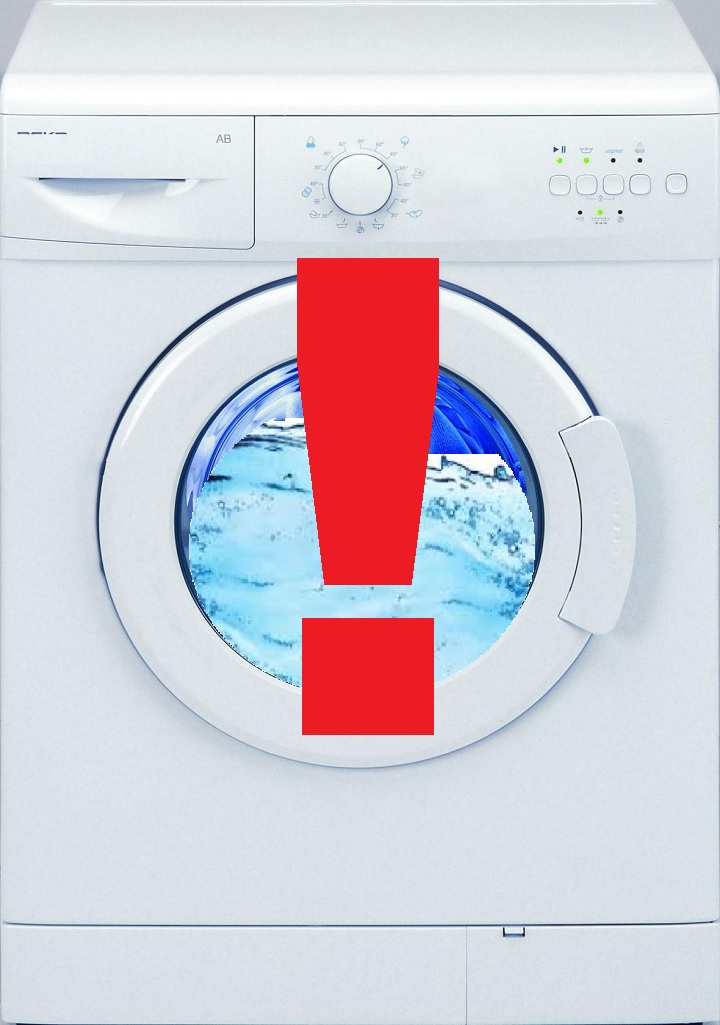
 You've loaded your clothes, selected the appropriate mode, pressed "start," and upon returning, instead of freshly washed laundry, you're greeted by complete silence and water in the washing machine.
Something definitely happened.
And before we figure out the reasons for this unfortunate incident, we first need to save the laundry from souring and spoiling.
How to drain a washing machine? This article will cover that.
A problem has been detected: the water does not drain on its own.
But how open the doorWhen the tank is full? And it probably won't work, since your machine likely has a safety feature that prevents the water from opening when the minimum water level is exceeded. How, then, can you drain the washing machine in this situation?
Five ways to drain water from a washing machine
Regardless of the brand, there are five ways to drain the water from the washing machine, if she hasn't done it herself. To implement this plan, you will need a basin, a flat-head screwdriver (knife), and floor rags.
Caution! To avoid electric shock, be sure to unplug the machine from the power source!
Here are a few ways to drain water from a stuck washing machine.
No. 1. Using a drain hose
The sequence of actions is as follows:
 disconnect the drain hose from the sewer cuff (or siphon) and remove it from the hose mounting bracket on the machine, if there is one;
- we lower the end of the hose pulled out of the sewer cuff (or siphon) into a basin;
- We lower the hose as low as possible to allow the water to flow into the basin under its own pressure.
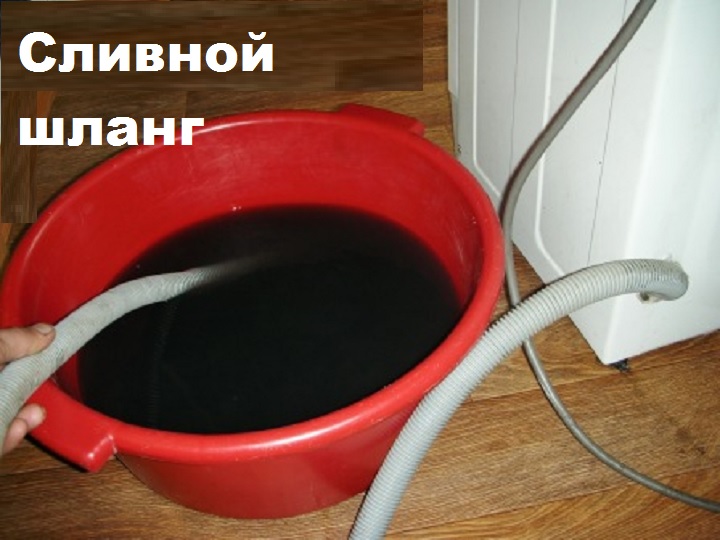
This is most likely how you can drain water from an Indesit, Ariston, or Samsung washing machine.
But it may not be possible to drain water from a Bosch or Siemens washing machine this way. These manufacturers often have internal protection against accidental water discharge, and this method is unlikely to help you in this case.
To understand whether or not you can drain the water this way, read what is written about this in the machine's instructions.
No. 2. Using a drain filter
If you remove the bottom panel located at the bottom front of the machine, you will find a special filter there that protects the drain pump from all sorts of things that end up in the drain from clothing pockets.
Using this filter, you can also drain water from the machine:
- remove the bottom panel (usually you need to pry it off with a knife or screwdriver)
- Carefully tilt the machine and lean it against the wall so that a basin fits under the machine; proceed with caution, the basin should not jump out;
- We turn the filter handle to the left (just so that it doesn’t fall out) and drain the water into a basin.
With this method, you will most likely have to do some extra work with a rag to collect any spilled water from the floor.
No. 3. Using an emergency drain hose
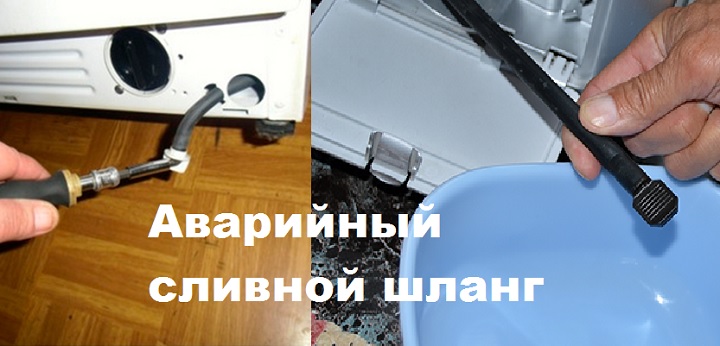 If your washing machine doesn't drain on its own, you can use the emergency hose. Of course, this is only possible if your washing machine is designed with one.
You can find it in the same place as the drain filter: in the lower compartment under the decorative panel.
You need to carefully pull out the hose tube, remove the plug and place the free end of the tube into the basin.
The emergency hose has a small diameter, so the process will take a long time. But everything will be done neatly!
No. 4. Using the hatch
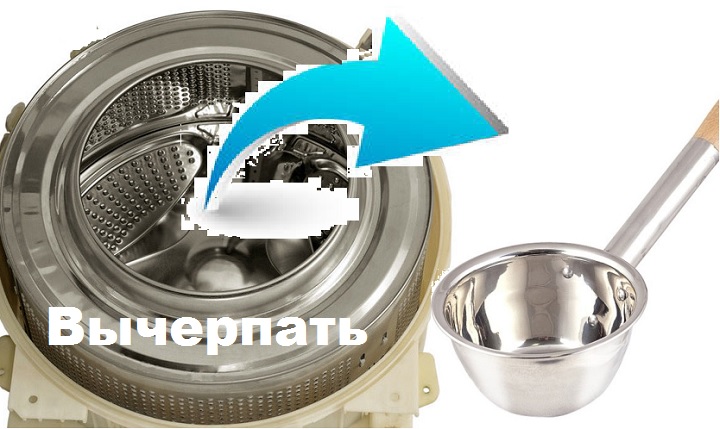 If the previous tips didn't help, you can scoop out the water from the washing machine directly through the hatch:
- If you can see water in the door window, you need to tilt the machine away from you and lean it against the wall, otherwise water will gush out of the machine as soon as you open the door and flood the floor;
- Next, open the door and scoop out the water manually (use a large, light mug or ladle).
This is a rather extreme method, because it takes a long time, is troublesome, and you won’t drain it completely.
This method will definitely not work if the machine door remains locked despite the machine being disconnected from the power supply and idle.
No. 5. Using the drain pipe
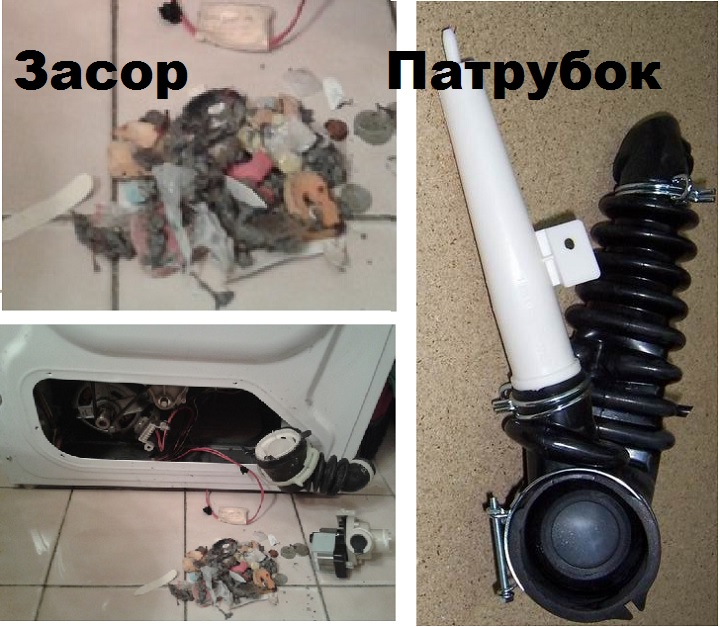 There is one last way to drain water from the washing machine.
Use the drain pipe.
During blockages it happens that even by unscrewing the drain filter, it turns out to be impossible to drain the water.
If this is what happened in your case, then by clearing the blockage, you will not only be able to finally open the machine, but you may also get rid of the reason why it stopped.
How to do it:
- You will find the drain pipe under the rear wall of the machine (the wall will have to be removed), directly under the drum;
- Place rags and a basin under the pipe, this is necessary to avoid flooding;
- disconnect the pipe from the pump by removing the clamp;
- If water spills, drain it into a basin;
- If the water does not flow, then it is necessary to remove the blockage (this can be done directly with your fingers).
The downside of this method is its complexity, but you will certainly drain the water from the machine and possibly eliminate the cause of the stoppage.
Economics of the problem
 The machine does not always stop with water due to a serious breakdown, as in the example with a clogged pipe.
In some cases, you can correct the situation yourself.
But if your washing machine breaks down and you have a question about how to drain the water, then call masters.
Below you will find the main causes of this malfunction and an approximate repair estimate:
| Pump | The drain pump burned out., and there is water in the machine. Solution: Replace the pump |
3400 – 5400 RUR |
| Drain filter | The drain filter collects small particles from dirty water that get into it during the washing process. Over time, the filter can become clogged and stop water from flowing. Solution: Cleaning the filter |
1000 – 1500 RUR |
| Control module/programmer | With this malfunction, the faulty board sends incorrect signals to the pump, and the water does not drain.
Solution: repair or replacement of the control module |
Repair:
2200 – 4900 RUR from 5400 RUR |
| Pressure switch | The sensor is not detecting the water level correctly and the machine stops the cycle. Solution: Replace the sensor |
1500 – 3800 RUR |
*The prices in the table are estimates and include both the cost of parts and the technician's labor. A final price quote will be provided by the technician after a diagnostic inspection of the problem.
If you have a question about how to drain water from a washing machine and you cannot solve the problem without outside help, call a technician.
How quickly can the problem of a washing machine stopping be resolved?
Within 24 hours, the problem will be resolved, and you can calmly go about your business without worrying about the safety of your laundry or a possible flood.
In addition, you will receive a guarantee for all work performed and spare parts used.
You will not regret that you contacted a specialist and chose highly qualified craftsmen.


