
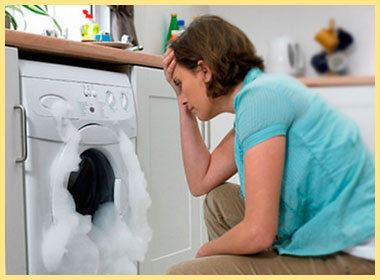
 A washing machine frees a woman from labor-intensive housework. A breakdown of the electromechanical device is a real disaster for a housewife.
All clothes and bed linens have to be washed by hand. If the family is large, then a whole mountain of clothes has to be washed every day.
Today we'll tell you what to do if your washing machine isn't working and how to fix this miracle machine yourself.
Why isn't my washing machine working?
If the unit does not turn on when you press the buttons and the indicators do not light, the reason for this may be:
- A short circuit in the outlet may cause the circuit breaker to trip, causing the lights and all appliances in the bathroom or kitchen where the appliance is located to go out.
What should I do if a short circuit is the cause? Flip the circuit breaker up, turning it on. The light will come on, and the washing machine will start working.
- A faulty outlet. To check the outlet, plug in any appliance or a table lamp. If the light comes on, the outlet is working properly, and you need to look for another cause of the washing machine's malfunction. You can check the phases in the outlet with a test screwdriver. If the other appliance doesn't turn on and the table lamp doesn't light, the contacts in the outlet have come loose.
Disconnect the power from the socket, remove its housing and inspect the contacts. They should be copper-colored, not gray, black, or green. If the contacts are oxidized, they need to be cleaned with sandpaper or a file.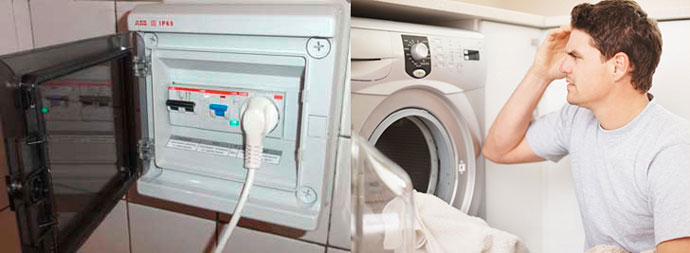
If holes appear in the contacts, the outlet needs to be replaced. Securely connect the wires to the outlet. Protect exposed wires with electrical tape. Use a screwdriver to tighten the contacts. To prevent the outlet from wobbling, tighten the mounting bolts.
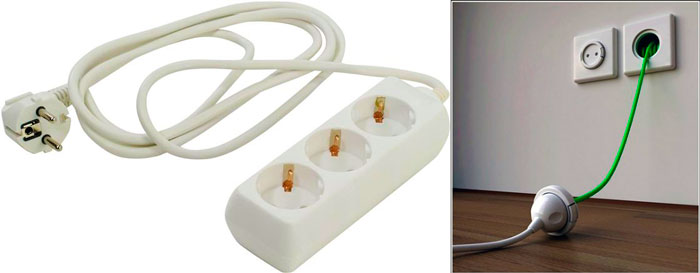
- The extension cord is faulty. Replace the extension cord or plug the washing machine cord into the outlet.
- The power cord is faulty. To check, you need to test it along its entire length with a multimeter in several places. Sometimes it's clearly visible that the cord is burnt and you can smell a burning smell.
- The power button does not work.

The washing machine does not work if the power button is stuck. Set the multimeter to buzzer mode and ring the button with the washing machine on and off. When the button is on, the multimeter should beep; when the machine is off, it should be silent.
- Noise filter failure.
 A washing machine interference filter is necessary to suppress electromagnetic waves emitted by the appliance. These negatively impact radio, television, and computer signals, causing interference. It also protects control unit from power surges that can cause the processor to burn out.
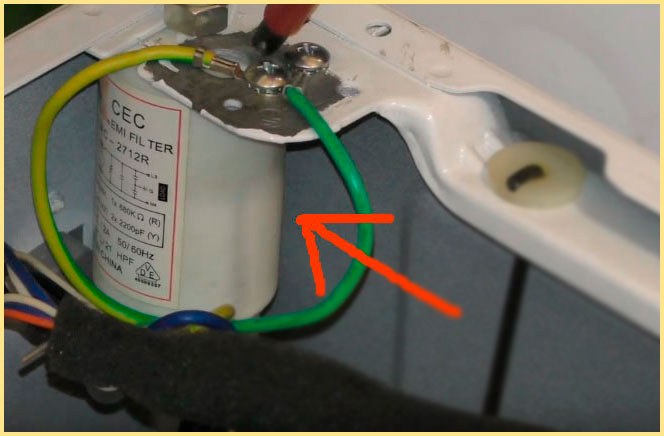
The voltage from the network goes to the interference filter, where it is normalized and then supplied to the board. If the interference filter is not working, the electrical current does not flow further along the circuit and the washing machine will not turn on.
To find out how the FPS works, remove the top cover and ring its 3 wires: phase, neutral, ground at the input and check the voltage at the output (2 wires: phase, neutral).
If the voltage does not reach the output, then the interference filter needs to be replaced.
- Control unit malfunctionTo repair it, it's best to contact a professional service center. However, if you have some knowledge of electronics, you can repair the board yourself.
The module's main component is a capacitor, or "konder," as they call it. Translated from Latin, "condensatus" means "condensed, compacted." It's a battery that can release its entire charge in a fraction of a second. This is its specialty.
What to do if your washing machine stops working because of the control module
- If the multimeter probes beep and show zero resistance when touching the capacitor, it means it's shorted. Capacitors in the control module are not repaired, but replaced, using a soldering iron. Several filters are installed along with them to reduce the risk of failure of the new capacitor. It is soldered to the positive electrode on the board.

- Often modules burn out due to resistors. First, you need to test the module. First-order resistors have a resistance of 8 ohms, and second-order resistors no more than 10 ohms. The overload on first-order resistors should not exceed 2 A, and on second-order resistors no more than 3-5 A. If the resistance is not within specifications, they need to be resoldered.
- If the capacitors are OK, then all the components of the control unit need to be tested. If the problem is with the thyristor unit, first measure the negative resistance. It usually fails due to power supply overloads and pulsed interference. If the unit is working, but the thyristor unit filter has burned out, then the cathode needs to be cleaned. A new filter is soldered through the positive contact.
- Sometimes the trigger in a thyristor unit fails due to a capacitor malfunction. To determine whether it's working properly, test it at the output contacts. The voltage shouldn't exceed 12V. If it's faulty, solder the output contacts and replace the trigger.
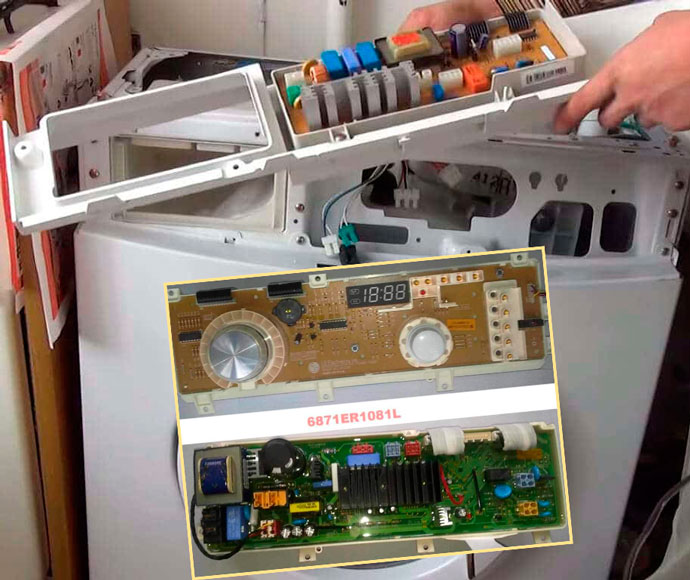
The power button lights up, but the program doesn't work. Reasons
- The laundry door lock isn't working. If power is applied to the input but the door doesn't lock, the program won't start. To check if the part is working, you need to test it.
There are 2 types of locks on UBL:
- thermal locks operating on bimetallic plates;
- electric locks with electromagnets.

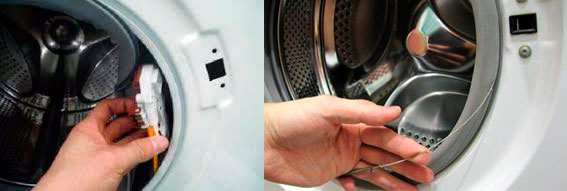
Most new-generation washing machines are equipped with thermal locks. A voltage is applied to the heating element, which heats it up and transfers the heat to a bimetallic plate. The plate, in turn, bends in response to the heat and locks the door with a latch.
A signal is then transmitted to the control unit to close the loading hatch, and the program begins to work.
When the wash is finished, the loading the hatch doesn't open right awayBecause when the thermal lock program is disabled, the voltage drops and the bimetallic plate begins to cool. Upon reaching a certain temperature, it returns to its original shape, thereby releasing the latch. The lock is released.
To test the lock, connect the tester probes to the lock contacts. The lock will close.
- If the thermal lock is working properly, then other parts should be checked.
- If the boot lock device hatch If it doesn't work, then it needs to be replaced.
The bimetallic plate deteriorates due to constant temperature fluctuations, causing the lock to jam. To repair the loading door lock, remove the clamp, then the rubber seal, then unscrew the screws on the sides of the lock, and remove the lock. Replace it with a new one: reattach the two screws, replace the seal, and secure the clamp.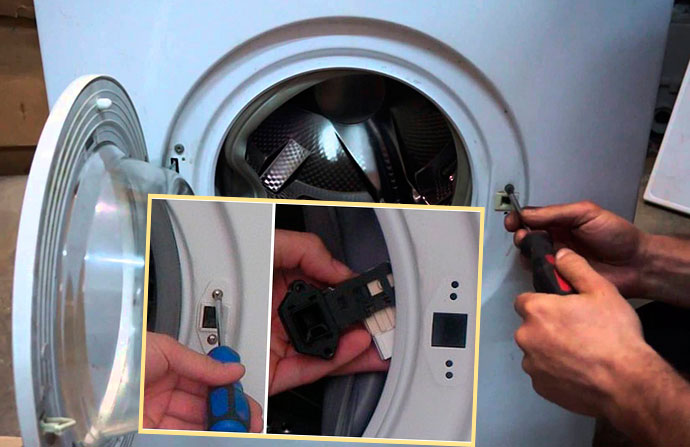
When you turn on the washing machine, the indicators flash simultaneously or in turn
Reason: The internal wires of the device are damaged.
To fix the damage, you need to test all the wires and replace the damaged section or call a specialist to your home. You can also take the machine to a service center.
The engine is faulty
Sometimes the washing machine will fill with water and start the program, but then there's noise and sparks during the wash cycle. What's wrong? What happened? Could the motor be broken or the brush be worn out?
There are three types of motors used in washing machines.
- Asynchronous. This type is used in older washing machines.
- Collector type. Installed in washing machines. Indesit, Electrolux, Zanussi, Candy, Ariston.
- Inverter. This type of motor is primarily used in modern Samsung and LG washing machines.

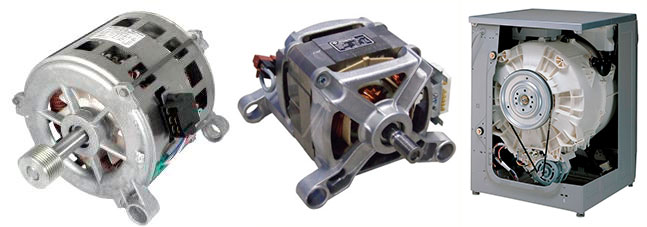
Commutator motors do not work:
- due to erasure brushesOver time, the brushes become smaller in size, which leads to incorrect operation of the motor;
- because of the lamellas. In the event of a power surge, the lamellas peel off;
- Due to the rotor and stator windings. An open or shorted winding makes the motor unable to operate.
Asynchronous motors are similar to brushed motors. An inverter motor is a direct-drive motor. If it fails, the system sends a signal to the display, displaying an error code.
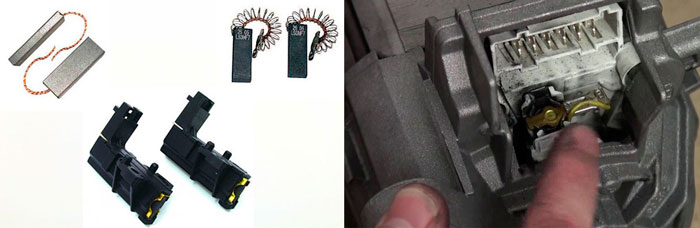
Replacing brushes
To replace the brush, you need to do the following:
- Remove the rear wall. To do this, loosen the bolts and pull the belt off the pulley and engine. Remove the fasteners from the engine and pull it toward you.
- Disconnect the wires.
- Remove the motor from the machine and inspect the brushes.

- If the brushes are worn, replace them. To do this, unscrew the screws holding the brush and the terminals with wires. Reassemble the machine in reverse order.
Repair of slats
A noise when turning the rotor by hand will indicate faulty fins. Visually inspecting the fins, you'll notice burrs and indentations that develop over time as the washing machine wears down the brushes. The brushes rub against the fins, causing unevenness. The rotor or stator may also short-circuit, causing the fins to peel off.
To restore the slats, you need to sharpen the anchor on a lathe. Clean the gaps between the slats.
If the winding is burnt out, it needs to be replaced. engineReplacing the motor isn't practical because the part is expensive. It's better to buy a new washing machine.
Today, we've uncovered the reasons why your washing machine won't turn on, and shared some tips on what to do if it's not working. Follow our advice, and your machine will work and bring you joy for a long time.


