
 Is your washing machine making a lot of noise and pulsating? This is a fairly common problem, and every machine owner encounters it sooner or later. It might be that the machine is loud from the start during the spin cycle, for example, but the noise can also develop as it continues to operate, and the causes will be quite different.
Unfortunately, it's impossible to make a washing machine completely silent, but you can significantly reduce the noise and rumble. So, why is my washing machine so noisy?
The structure of a washing machine
Let's first understand the structure of a washing machine and why vibration occurs. The drum is secured to the machine body by a system of springs and dampers—a type of shock absorber designed to reduce vibration from the drum's centrifugal force. The motor rotates the drum via a belt and a large pulley, often made of duralumin, which bends easily. Ballast is often suspended from the drum as a counterforce to compensate for this deflection.
Details
The most common causes of noise
Having understood the design, let's look at why the washing machine makes noise.
 Another possible cause is the shipping bolts located on the rear panel. They are attached to the tank to protect it from damage during transit. If these bolts are not removed immediately, the main components will begin to wear out much sooner.
- Overloading the drum. If the machine's instructions state a 5 kg load, don't load it with more laundry than that. It all comes down to the laws of physics, and the manufacturer specifies a maximum load for a reason: the ballast suspended from the drum can counterbalance the torque, preventing the machine from bouncing around like crazy. Loading more laundry than the manufacturer's maximum load will create excessive vibration and vibration, which will only damage the machine's components faster.
- A very common cause is improper installation of the washing machine. The washing machine should be placed on a surface that's as level as possible. You can even check its levelness by placing a spirit level on top. The reason for the wobbling is that the drum inside the machine will also tilt due to the uneven surface, and the automatic washing machine will try to return it to its original position, which will create excessive noise.
-
Sometimes a small object gets caught in the space between the tank and the drum. You can find it by the sound it makes by rotating the drum by hand. You can remove it by bending back the seal.
- The worst case scenario is when something inside the machine actually breaks down, causing the drum's center of gravity to shift. This is why a washing machine that was relatively quiet yesterday may suddenly start making noise.
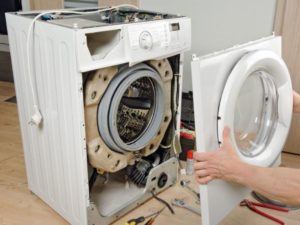
Importantly, manufacturers are constantly improving washing machine design, for example, by installing special sensors to ensure the laundry is evenly distributed throughout the drum, dampening unnecessary vibrations and shocks. Automatic systems simply slow down the spin speed.
Solutions
Let's figure out how to fix some of the problems.
Incorrect installation:
Checking this is fairly simple: use a level large enough to be equal to or larger than the edge of the washing machine, ensuring the most accurate measurements. Use the level to measure all four sides of the washing machine, then adjust the feet on which the washing machine rests until the level is level. Of course, it's best for the floor to be level as well, as the feet can twist slightly when the washing machine bounces. You can place a small amount of rubber under each foot to compensate for this.
Bearing failure
The most common cause of noise during the spin cycle is a broken bearing. This problem is unavoidable because these parts have a lifespan, and when it wears out, the machine starts making noise. Worse yet, a failed bearing can cause leaks, which may require replacing other parts. This can be easily checked: open the machine and spin the drum. If the rotation is uneven or the drum is difficult, the bearings are faulty. You can also rock the drum up and down; if it moves significantly away from the drum, the bearings are the culprit.
Important: It is very difficult to replace the bearing yourself; you need to disassemble the entire machine, so it is better to contact a specialist.
Wear of springs
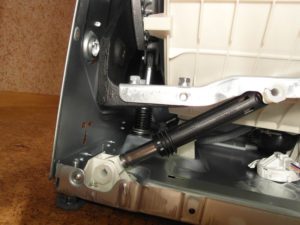 A washing machine typically has 2 to 4 springs. These springs are typically made of thick spring steel, with rods at least 3 mm thick on both ends. These rods suspend the spring within the housing and hold the drum in place.
They ensure free rotation of the drum and slight movement, and they also compensate for the oscillation of the housing when high centrifugal force occurs. In some cases, the manufacturer may use low-quality springs, which can cause the drum to deform at high rotation speeds, causing the washing machine to move.
You can check this by pressing on the tank with your hand. If it quickly snaps into place, then the springs are fine. If the tank wobbles, then you should consider the possibility of worn springs.
Important: You can't fix this type of replacement yourself; it's best to contact a professional, as they can use a special device to accurately measure the drum's deviation from the center and can accurately determine whether one or more springs are stretched and replace them.
The damper has failed
The damper acts as a shock absorber in a washing machine. It prevents the drum from bouncing up and down as it rotates. Over time, the damper wears out and becomes unusable, causing the drum to wobble within the machine.
The pulley is bent
Although duralumin is a fairly durable material, it is possible that during use it could bend or even a piece could break off.
Important: These two faults are difficult to detect, let alone repair; it is better to contact a service center.
Conclusions
Here are the main causes of noise and vibrations in a washing machine. If you're wondering why your washing machine is making noise, it's best to use the process of elimination, from the simplest causes to serious malfunctions. If the surface is level, the feet are adjusted, and nothing has gotten inside the drum, it's time to contact a professional; perhaps a component inside the machine has failed.


