
 Few people are surprised by automatic washing machines these days, as even the newest models with unique technologies have become taken for granted.
Tank illumination, automatic weighing, ergonomic design and intelligent controls have become characteristic and almost commonplace for automatic washing machines.
But how then does professional, industrial equipment differ from household washing machines?
It might be worth installing a reliable, professional-grade washing machine in your home that will last for decades, but what are its advantages and disadvantages? Let's take a closer look.
Where can professional washing machines be used?
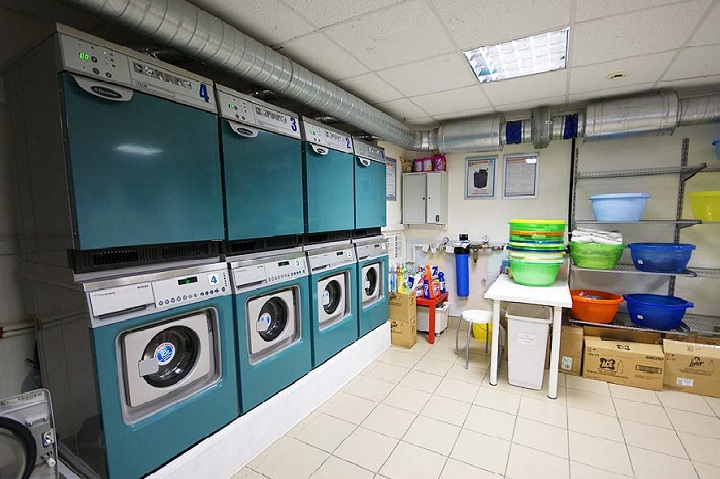 Industrial, professional washing machines are used in all aspects of modern life and activity. And these aren't just the laundromats we imagine, where people bring their laundry from various places and homes.
Such professional equipment is used:
- In hotels and small inns, the presence of such expensive, high-quality machines only enhances the building's service. Furthermore, it's much more convenient and cost-effective to do your laundry in your own mini-laundry room, located in the utility room, rather than constantly taking your laundry to the dry cleaner. Your room linens will always be clean, and guests' clothes can also be laundered for an additional fee.
 In self-service laundries, which are often installed in cottage-type settlements.
- In restaurants where strict sanitary requirements must be met, as well as for serious business, daily laundry will help keep table linens in the dining room and chefs' uniforms clean.
- In food processing facilities, such as dairy and meat processing plants, confectioneries, or bakeries, installing your own professional washing machine is also much more cost-effective than using a local dry cleaning service.
- In hairdressers and large beauty salons.
- In hospitals and perinatal centers (maternity hospitals).
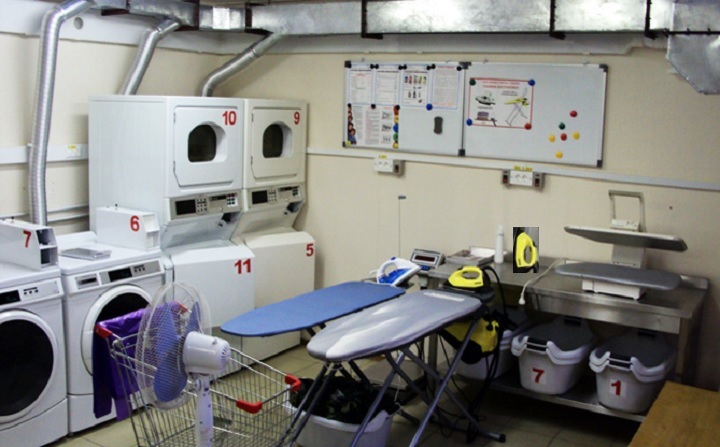
Important: If the business volume is small, then instead of a professional-type washing machine, you can install a semi-professional automatic unit.
Professional automatic washing machines for laundry
Comparison of professional equipment with household equipment
What's so special about professional washing machines, and how do they differ from household or semi-professional devices?
Advantages in favor of the pros
 Wash quality. Only professional equipment (in our case, washing machines) achieve the highest performance in this area. Semi-professional machines are slightly inferior in this area, as they are largely based on the design of household machines. However, in some cases, the difference in washing results is almost impossible to notice.
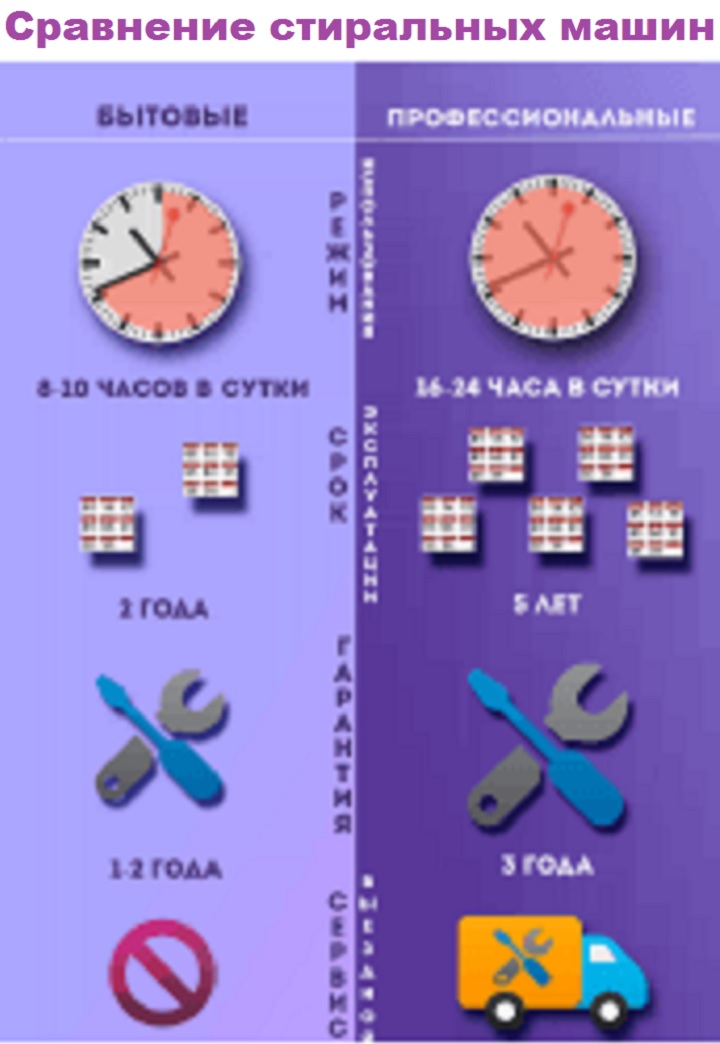
- Wear of parts. Industrial machines are designed for at least 30,000 wash cycles, while semi-professional machines are designed for 5,000, and household machines for about 1,000. And this is all assuming that household and semi-professional machines should be washed with short breaks, otherwise overheating of the heating element will require replacement parts. Semi-professional machines should be used no more than 14-21 times a week, while professional machines can be used 24/7.
- Washing speed. In professional washing machines, this time is reduced to 45-60 minutes, allowing for more frequent washing. This is made possible by the use of multiple heating elements. Home washing machines typically last two hours.
- Warranty period. If a household washing machine is used in a commercial setting rather than a home, it is not covered by the warranty, and if something breaks, repairs will be paid for. Professional machines have a significantly longer warranty period for certain parts.
- Drum size. In industrial type machines it is much larger, which makes the process of unloading laundry easier.
Please note that all professional-grade washing machines can use liquid gel-powders for washing without damaging the insides of the machine, which cannot be said about household and semi-professional devices.
Disadvantages of professional automatic washing machines
While professional washing machines have their advantages over household ones, many may wonder, "Why don't consumers buy these machines for home use if they're so reliable and durable?" That's because there are also some drawbacks that simply can't be ignored.
 Price. This is perhaps the most important factor for most potential buyers. Professional automatic washing machines are very expensive; their price makes them considered premium washing machines.
- Dimensions. Such machines are never narrow or compact. They are often even larger than standard washing machines, which doesn't meet the needs of people who need smaller machines for their small apartments. Only those with larger homes, capable of setting up their own laundry room, can afford such devices.
- Cost-effectiveness. Almost all professional-grade washing machines cannot be considered energy-efficient. They consume up to 100 liters of water per wash cycle. The same applies to energy consumption.
- The mentality of producers. Many people tend to upgrade their appliances from time to time and embrace new technologies and inventions, opting for models with more appealing features and designs. People are used to upgrading their phones, cars, and washing machines, too. Therefore, many believe it's better to buy a budget device that they won't mind throwing away in 5-6 years and buying something new.
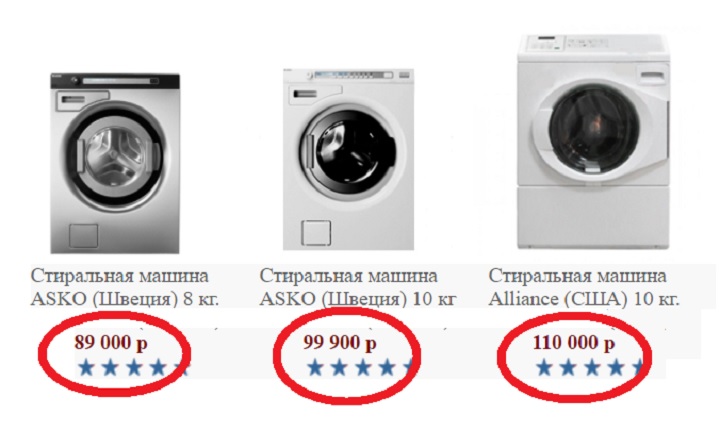
Conclusion: as we can see, it is for this reason that professional machines are preferred to be used only in production facilities, and not at home.
Model overview
Let's look at several interesting models of professional washing machines and their brief characteristics.
Professional automatic washing machines are produced by well-known brands such as Miele, LG, ASKO, and Fagor. Here are a few of them.
 Vega B-10 – a professional automatic washing machine with a 10-kilogram load capacity. It has 50 different washing programs, 10 of which are built-in. The controller can read SD cards. Spinning is, to put it mildly, mediocre, as the moisture content of the laundry remains at 70% after unloading. Furthermore, the machine's appearance leaves much to be desired. Dimensions: 0.81 x 0.76 x 1.24 meters. Manufacturer (country): Russia. Price: 145,000 rubles.
- LG WD-12A9 – an automatic washing machine that can wash up to 6 kilograms of laundry at a time and spin at up to 1200 rpm. Each wash cycle uses 66 liters of water. The front panel and body of the machine are made of painted steel. The drum is also made of steel. Dimensions: 0.6 x 0.65 x 0.55 meters. Price from 60,000 rubles.
- LG WD-1069BD3S – an automatic washing machine with a load capacity of up to 10 kilograms and a powerful spin speed of up to 1150 rpm. The body and drum are also made of steel, like the previous model. Dimensions are 0.69 x 0.93 x 0.75 meters. The price varies, but is typically no less than 104,000 rubles.
 Miele RW6080 Vario – a front-loading washing machine designed to wash eight kilograms of laundry and spin at up to 1300 rpm.
- It has 70 washing programs, which are even divided by the type of purpose and use of the machine: "Sport," "Hotel," "Kitchen Linen," "Stable," and others. Energy consumption is enormous—7.9 kW/hour. This unit is manufactured in Germany. Price starts at 460,000 rubles.
- 425865 ASKO WMC84V – This professional washing machine has a capacity of up to 11 kilograms and a fantastic spin speed of 1400 rpm. It has 22 programs and can be connected to either cold or hot water. The stainless steel tub ensures durability. The system includes a 6-stage leak protection system. Dimensions: 0.85 x 0.6 x 0.7 meters. Price: not less than 165,000 rubles.
 Fagor LA-25 ME – This washer has a 25-kilogram load capacity and a spin speed of only 900 rpm. It has 16 programs, all controlled via the electronic panel. The drum capacity is approximately 250 liters. Made in Spain, the dimensions are 0.98 x 1.04 x 1.56 meters. The price range isn't for everyone—it starts at 450,000 rubles.
- LАVАRINI LM14 – washing equipment with a 14-kilogram load capacity. The body is made entirely of stainless steel, and the machine is controlled by a microprocessor with a graphic display. It features a self-cleaning function. The machine's memory stores up to 200 washing programs. It is made in Italy. Dimensions are 0.88 x 0.93 x 1.34 meters. Prices start at 650,000 rubles.
- Unimas UY180 – This washing machine is designed for a 18-kilogram load. The stainless steel body makes it ideal for laundries. Microprocessor control allows for the storage of up to 100 programs, 20 of which are pre-programmed by the manufacturer. The drum opening is 0.75 m. The country of manufacture is Belgium. Dimensions are 0.97 x 0.97 x 1.41 m. Price starts at 730,000 rubles.
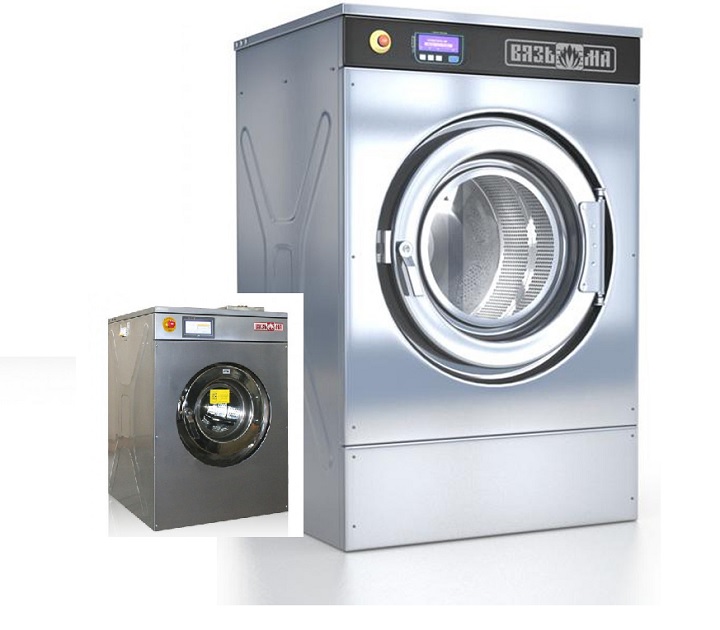
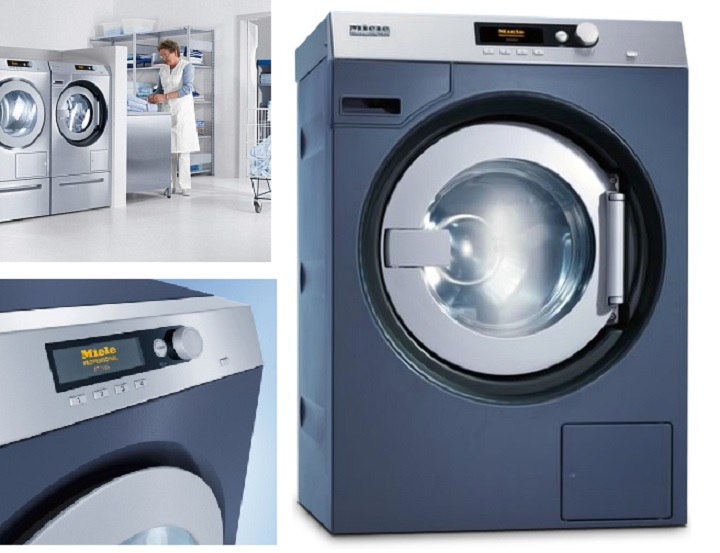
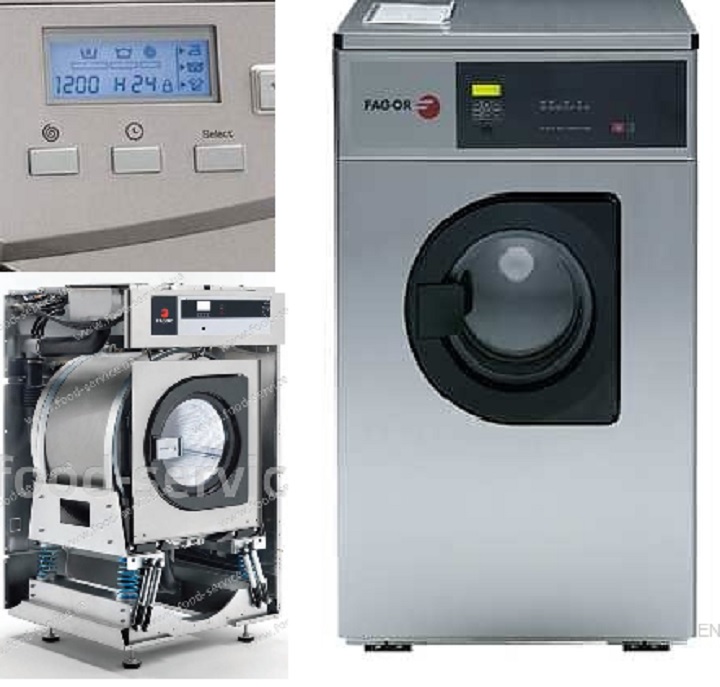
As we can see, professional equipment is expensive and generally unwise for home use. It consumes a lot of energy and water, although its reliability ratings are truly impressive.
Just think: for the same price, you could replace your washing machine literally every 4-8 years, while professional washing machines costing up to 100,000 rubles are questionable. So before buying an industrial machine for your home, consider that using it for its intended purpose would be far more justified given the overall costs involved.


