
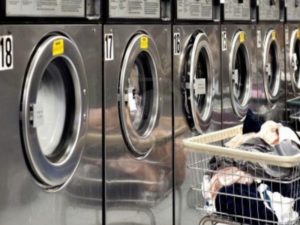
 Industrial washing machines – types and prices
Industrial washing machines differ significantly from household ones, and not just in price. They have a wide range of features and are divided into specific subtypes. There are also specific selection criteria that must be considered to ensure you'll never buy a great machine.
Construction equipment is produced by a variety of manufacturers. But to make the perfect choice, it's important to first consider the key features of a particular company and focus on its overall specifics.
A rather important feature that distinguishes industrial machines is their increased dry laundry load capacity. It's quite rare to see a domestic model with a capacity greater than 10 kg. A capacity greater than 15 kg is completely unheard of among domestic machines.
Advantages and disadvantages, features
However, in the industrial segment, it's not uncommon to find models that can wash anywhere from 25 to 100 kg or more at a time. This isn't practical for a home, even for a family with three or more children, but it's a practical solution for a dorm, hotel, or similar environment. An equally important difference is the design of the wash cycle.
Industrial machines typically have programmers that allow the user to set up to 200 different programs. In comparison, home models are available with up to 30 different modes, and these are considered premium devices. The wash cycle time for a full load of natural cotton items is limited to 1 hour.
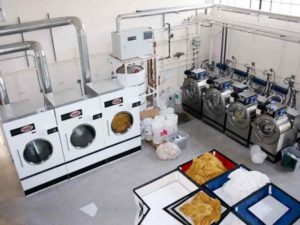 In domestic washing machines, this cycle is designed to last at least a couple of hours. The reason is clear: specialized laundries have a strict rhythm and schedule that must not be disrupted. There are even differences in reliability and the permissible intensity of use. A domestic washing machine, even a VIP-rated one, can normally be used a maximum of 11 times a week.
If this condition is met, a household appliance can be used for 7-10 years. After that, its key qualities will begin to deteriorate irreversibly. In this regard, professional equipment is much better. It can operate perfectly for 20 consecutive hours a day, completing up to 30,000 cycles per year. And if appropriate maintenance is provided, professional appliances will last reliably for at least a quarter of a century.
If you try to use a simple household washing machine for a laundry, no manufacturer will support its warranty. Not to mention, the machine will break down long before its expected lifespan. Another caveat is that dry cleaner and laundry models operate almost autonomously. They are equipped with highly advanced processors, requiring very little operator intervention. The general conclusion is that both industrial and household washing machines are good, but each is suitable for different applications.
Details
Types of devices
The classification of industrial washing machines, which can be purchased in specialized stores, can vary greatly.
By types of pressing
Automatic laundry machines can be divided into two main groups: low-speed and high-speed. The first category includes equipment capable of spinning at no more than 1,000 rpm. At this speed, laundry will retain no more than 50% of its original moisture. The motor in high-speed spin machines operates almost silently. This is achieved by mounting it on a special frame equipped with shock absorbers. All that is required for this type of equipment is a perfectly flat, moisture-resistant surface. Low-speed models can spin laundry at a maximum of 800 rpm. This results in fabric moisture levels of up to 80%. Installation of "slow" machines for washing special clothing and other structures is complicated by the rigid attachment of the drum to the machine. When the spin cycle begins, severe vibration occurs, which can only be compensated for by a high-quality base.
The foundation height should be at least 0.3 meters, and with a lesser support layer, protection is completely unreliable. Machines with poor build quality are often made of stainless steel. This equipment will find wide application in marine and river transport, as pitching and rolling can seriously damage high-speed units. The drum can be positioned both horizontally and vertically.
By type of control
Industrial washing machines with spin-dryers come in two different designs: those with automatic control and those with a programmer. Fully automatic models operate (as judged by operators) in the same way as household machines. When managing washing programs, you can set the water temperature, spin speed, and other important parameters. Programmable models are equipped with a microprocessor panel, which is considered a full-fledged multifunctional PC. This allows you to adjust the cycle time and the required detergent consumption.
By type of water heating
Like household appliances, commercial washing machines are usually equipped with heating elements. These models are much more expensive than others, and they are also very popular. Gas and steam heating are sometimes used. These can be combined with electric water heating. The problem is that using gas and steam heating without connecting to a separate boiler is unrealistic.
By loading weight
It's worth noting that some professional washing machines, even those supplied by large companies, only nominally deserve this title. These models are rated for 12 kg or more. They are most likely suitable for small laundries, small hotels, small kindergartens, or private hospitals. Full-scale fitness clubs, hotels, and hospitals recommend using equipment rated for 25 kg or more. These units include high-end models from renowned companies. Some experts suggest that large laundries or hotels at the federal level should use washing machines with a 30 kg capacity. These machines can wash up to 2.5 tons of laundry per shift. The selection of 30 kg capacity machines is quite wide, so you can find the perfect one. As for 50 kg capacity machines, such equipment is ideal for:
 Industrial enterprises.
- Various sports clubs.
- Dance and sports schools.
- Recreation centers and large private houses.
- Sanatoriums.
- Huge hotels.
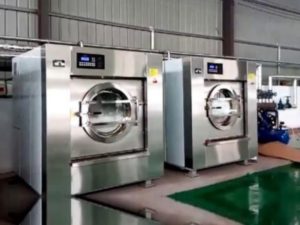
Now let's talk about the best manufacturing companies.
TOP manufacturing companies
Miele appliances (particularly the PW6321) have repeatedly demonstrated excellent results. This machine features advanced computerized controls. The drum can hold up to 32 kg of laundry. Spinning speeds up to 1,000 rpm are available, and the following features are worth noting:
- Washing respirators.
- Disinfection.
- Impregnation of fabrics.
- Treatment of special clothing.
- wetCare.
The LG WD-1069BD3S is ideal for small businesses. It's more of a semi-professional model, with a capacity of just 10 kg. It features electric water heating and five ideal programs. Information is displayed on the LCD screen. A self-diagnosis function is also available. The Vyazma B080 industrial washing machine is ideal, as it holds up to 80 kg of dry laundry and offers up to 50 different washing modes in automatic mode. Crucially, the machine is designed for a 380 V network. There are only two main drawbacks: installation difficulties and bulk. This company offers machines with capacities ranging from 10 kg to 240 kg.
Among them we highlight:
- at high speed.
- Pre-squeeze.
- Manually operated, low grade.
- Hygienic barrier detergents for washing.
Primus products will include models with a capacity of up to 180 kg. This Belgian company also offers unsprung machines. Many versions feature automatic error detection, with all information displayed on the screen. They also offer a line of barrier washing machines, which reliably separate dirty and clean water. The housings are typically made of select stainless steel.
Recommendations for selection
Enough has already been said to understand that the main characteristic of professional washing machines is their capacity. If it's larger or smaller than the owner's needs, the result will be cost-ineffective. Once this is clear, we can move on to the program list. This should also be selected individually based on personal needs and tastes. It's almost always important to choose washing machines with automatic electric heating. In addition to these parameters, consider:
- The whole size.
- Current consumption.
- Connecting the water supply.
- Device design (extremely important for hotels and commercial laundries).
You can see an overview of an industrial washing machine in the video. These units aren't available in all stores, but the best place to buy them is on Yandex Market.


