
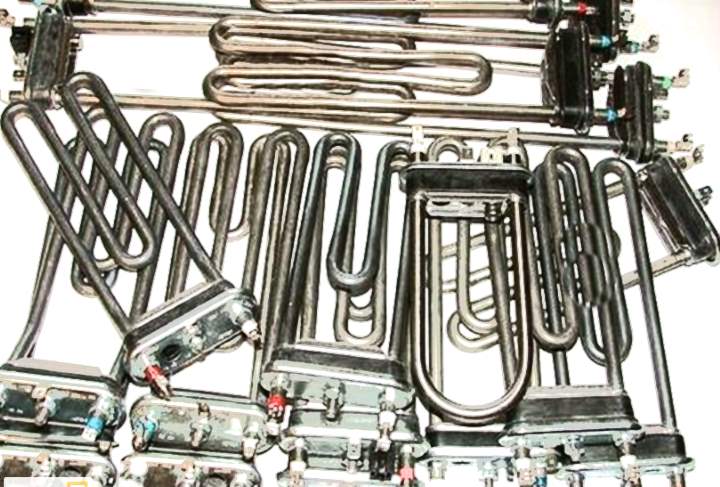
 Automatic washing machines are typically connected to the water supply, sewer line, and electrical outlet. However, they only require cold water, as they heat the water themselves using a built-in heating element.
A heating element is a heating element in a washing machine.
It heats the water to the desired temperature, which is programmed into the machine..
This article will explain what a heating element is and how it works. You'll also learn how to choose the right heating element when purchasing, how to test it, and how to install it.
- How does a heating element work in a washing machine (operating principle)
- Design
- Power
- How to check the cause of a heating element failure
- Location of the heating element in a washing machine
- How to choose a new heating element for your washing machine
- Form
- Fastening system
- Other parameters
- Where to buy a heating element for a washing machine
How does a heating element work in a washing machine (operating principle)
Installation instructions are the same for almost all automatic washing machines, as their design is very similar. If the heating element fails, further operation of the washing machine becomes impossible – it stops running the program and displays an error message.
Design
In an automatic washing machine, the heating element is a tubular structure responsible for heating the water. At the center of this structure is a thin conductor made of a special alloy with high resistance and capable of reaching high temperatures without breaking. A dielectric material with high thermal conductivity insulates the coil from the steel outer shell.
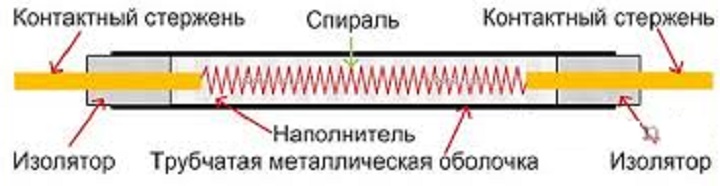 The ends of the coil are soldered to the contacts, and power is supplied to them. A heating element, which measures the temperature of the water in the washing machine's tank, is often located here. When a program starts, power is supplied to the heating element from the control unit, which heats up and begins heating the water. Once the set temperature is detected by the sensor,, The control unit will turn off the heating element and the water will stop heating.
Power
Sometimes the heating element power reaches up to 2.2 kW. The more powerful the heating element, the faster the water in the machine heats up and the faster the wash cycle begins. It's also crucial that heating elements have high inertia and resistance, making them virtually unaffected by power surges. Short-term increases in line voltage have no visible effect on the conductor inside the heating element. This increases the lifespan of the heating elements.
How to check the cause of a heating element failure
As mentioned earlier, a distinctive feature of heating elements is their reliability. Therefore, they most often fail for the following reasons:
- Scale deposition.
- Factory defect.
Unfortunately, it's impossible to insure against factory defects, but if your car is still under warranty, you can simply take it to a service center and wait for it to be repaired.
By the way, when purchasing a machine, carefully check that the documents and warranty cards are filled out correctly (for seals, etc.). The worst enemy of heating elements is scale. It settles on the outer part of the housing, preventing heat transfer to the water. Due to its low thermal conductivity, scale causes the heating element to overheat. Overheating can cause the heating element to burn out. To prevent this, use an anti-scale product..
 The formation of scale is also dangerous because it contributes to the formation of rust on the metal casing of the heating element of the washing machine.
As a result, its integrity is compromised, creating the risk of a short circuit. This is why scale must be actively addressed.
Before completely replacing the heating element with a new one, you need to check it first.
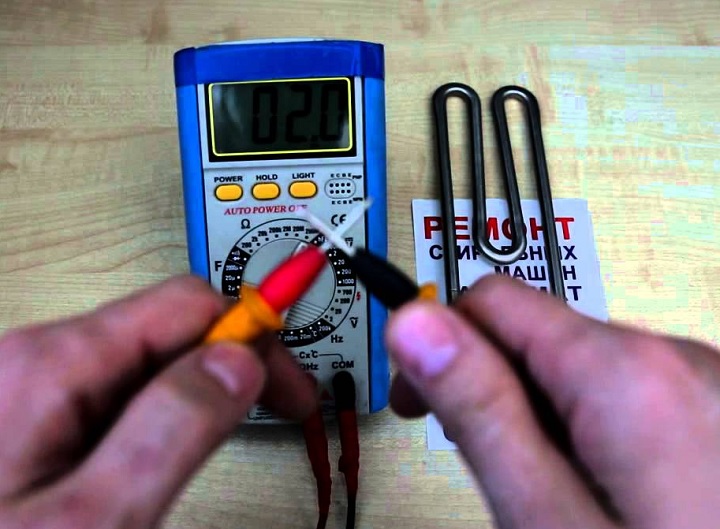
To do this, you'll need all the necessary tools, primarily an ohmmeter or a multimeter with an ohmmeter mode. You'll need to check the heating element for resistance and ensure there's no leakage into the washing machine body.
Basically, the resistance of a heating element ranges from 20 to 40 Ohms (it all depends on the power of your heating element).
And speaking of leaks, when the heating element is in good condition, the ohmmeter should show no resistance. The test is performed by measuring the contacts and the housing for resistance. The ohmmeter will automatically adjust to its maximum operating range (it can measure tens or even hundreds of megohms).
You also need to check the control module for power supply voltage. To do this, you'll need to purchase a voltmeter or use a multimeter with an AC voltmeter setting and attach it to the heating element contacts. Once the probes are on the contacts, run any program and wait for voltage to appear. If there's no voltage, you need to check the control module.
If the resistance between the housing and the heating element contacts is very low, you should stop using this washing machine, otherwise you may be shocked by electricity.
Location of the heating element in a washing machine
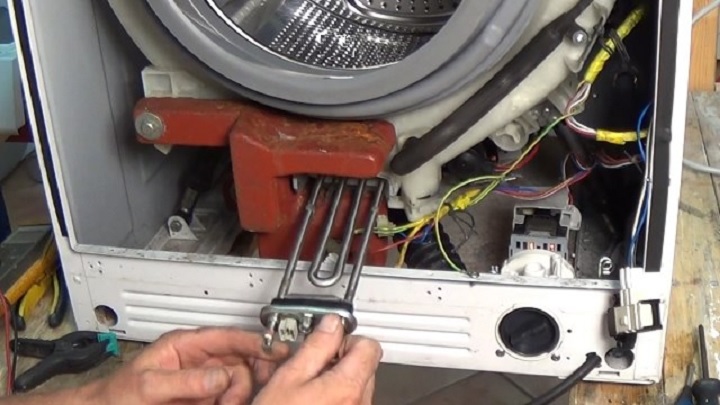 To find the heating element, you need to remove the back panel. Once you've removed the cover and set it aside, you'll see the plastic tank underneath, which will house the heating element contacts and the temperature sensor contacts. In some cases, the heating element contacts are located on the side, so you'll need to remove the side panels to access them.
If you find the heating element contacts at the top, these aren't the ones you need. This is the dryer heating element, which isn't of interest to us right now, but it's worth checking, and it's checked the same way as the water heating element.
To measure resistance, there's no need to remove the heating element itself. You can also locate the temperature sensor contacts near the heating element or between its contacts.
Replacing the heating element is easy. Simply unscrew and remove the faulty element, replacing it with a new one. Once all the fasteners are tightened, check the tank for leaks.
How to choose a new heating element for your washing machine
Heating elements differ mainly in their shape.
Form
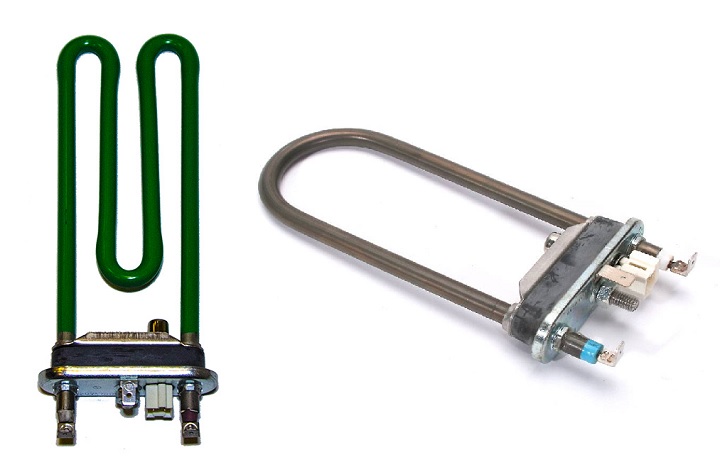 The most popular are U-shaped and W-shaped heating elements.
All heating elements have contacts located at the back.
You may also come across heart-shaped heating elements. There may also be spiral heating elements, like those found in old electric kettles and samovars.
Fastening system
In addition to their shape, heating elements can differ in their connection and mounting methods—the fasteners and terminals can have a variety of shapes. The fasteners are typically nipples with flanges of varying diameters. The same applies to the contacts of the groups, where the washers connect to the wires.
Heating elements may also have special fuses and temperature sensors that can protect them from overheating, a common occurrence caused by scale buildup. These contact blocks are located near the heating element contacts.
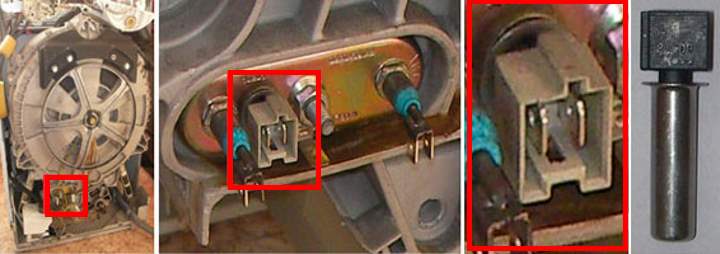 Because of this, it is very difficult to find an equivalent heating element for your washing machine.
The best option would be to purchase exactly the same heating element as your old one, with the same connection and fasteners.
However, if you were unable to purchase an identical model, you will need to work hard to connect the new heating element to the wiring and seal the area where it will be installed.
Other parameters
It's also important to consider the heating element's wattage before purchasing. The parameters of the old and new models should be identical – this way, all washing programs will work perfectly, the water will heat up quickly, and the self-diagnostic system will check correctly.
If your washing machine is quite old and finding new parts is difficult, you should consider heater models that are compatible with the old ones. While connecting and installing them can be quite complicated, it's much easier than repairing the entire washing machine.
Where to buy a heating element for a washing machine
Trying to repair your washing machine yourself is considered a cost-effective option. Finding new parts for your washing machine is a difficult task, as they aren't sold in appliance stores. However, such problems can be resolved by simply ordering the necessary parts from a service center or online. However, keep in mind that these will be very expensive.
The most optimal and effective option is to purchase heating elements and other parts for your washing machine from online stores that sell such parts.
Finding them isn't difficult. Just enter the following words into any search engine: (the part you need, in our case, the heating element model you need) for your washing machine (your model).


