
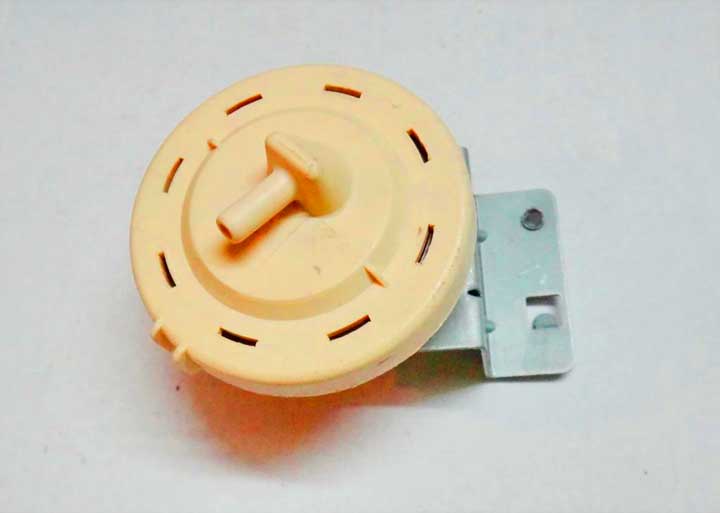
 Every washing machine has an important device called a pressure switch.
This is a sensor that monitors the level of water poured into the drum and reports electronic module technology about its quantity at each stage of washing.
Modern machines are equipped with sensors that not only monitor the water level but also the amount of laundry loaded.
Washing machine pressure switch design
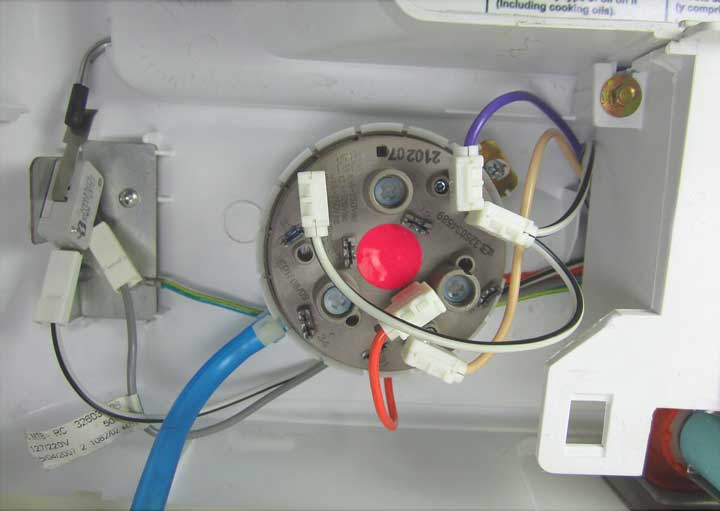 The pressure switch of a washing machine looks like a disk with an air chamber located inside, equipped with wires and a tube, the other end of which is located in the tank of the washing machine.
The incoming liquid increases the air pressure both in the tube and in the pressure switch chamber.
This causes the piston to rise, pressing on the contact plate beneath the spring. This continues until a certain amount of liquid is reached.
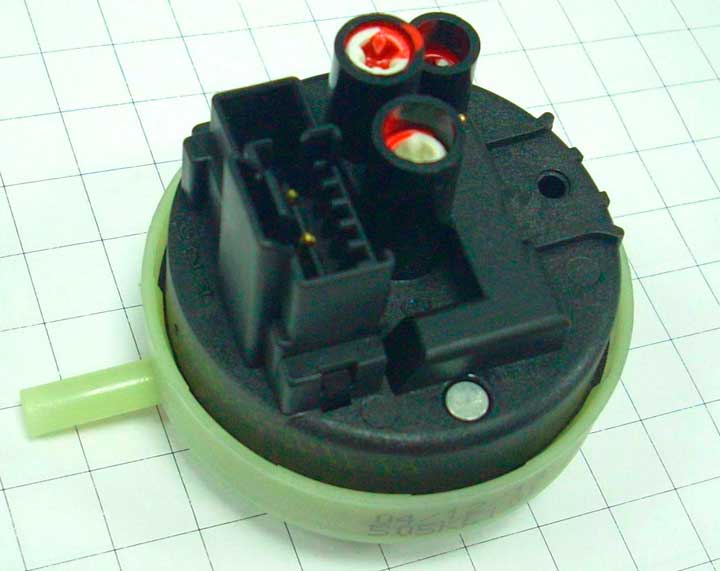 Then the electrical circuit of the input relay lamellas is closed due to the switching of the spring plate to the upper position.
When the water drains, the pressure decreases and the piston slides downward, causing the relay to switch downward, breaking the electrical circuit. The module then transmits information and commands to the pump, heater, inlet valve, and motor.
With proper operation, a washing machine's water level switch can last up to 10 years. If the pressure switch fails, the entire washing machine will malfunction and errors will occur.
Signs of a faulty pressure switch
If you have problems with the water level sensor, you can visually identify them by the following indicators:
- uncontrollable (a lot or a little) water collection into the tank or vice versa drain, this threatens to flood the premises;
- characteristic the smell of burning;
- weak spinning of laundry or the machine’s refusal to perform this function at all;
- Even without water, the equipment can turn on the water heating and start washing, which usually leads to overheating and combustion of the heating element.
Self-diagnosis of the pressure switch's performance
If signs of a faulty water level sensor appear, it is advisable to verify that it is not working, as the problem may lie elsewhere.
To check the sensor, you'll have to remove it. Where is the pressure switch in the washing machine? Inside the machine, to get to the part you will have to:
 Remove the top cover of the device by sliding it backward. To do this, you need to unscrew the screws on the rear panel.
- The pressure switch in the washing machine is attached to the side panel and held in place with screws. Disconnect the wires and the hose leading to the fitting from the part. The hose is attached with a clamp that can be extended or unscrewed.
- Now you can unscrew the screws and remove the sensor.
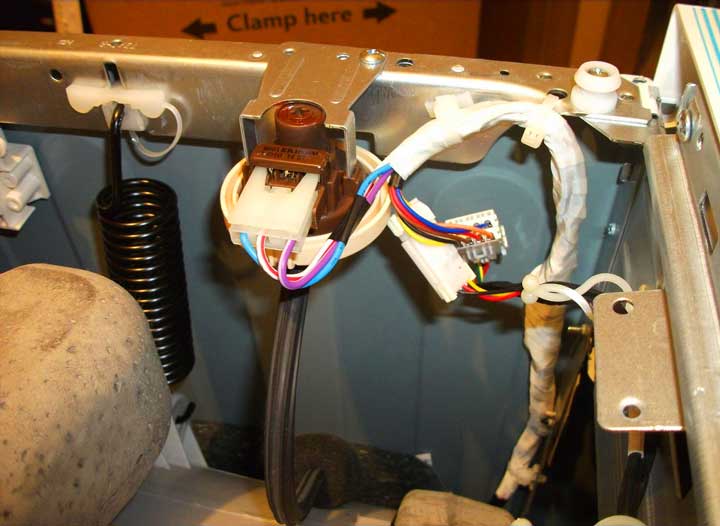
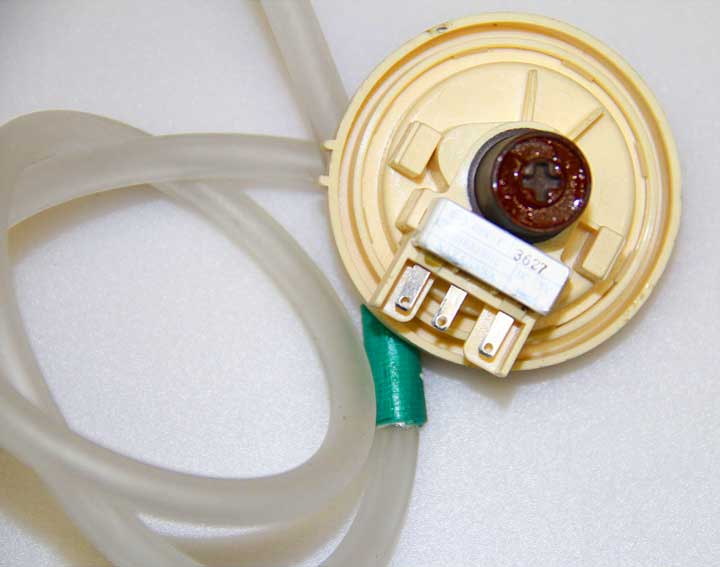 When inspecting the part special attention should be paid to the tubeIf external damage or blockage is visible, perform the appropriate repairs: replace it if damaged, and clean it if clogged. Sometimes a hose may come loose, which indicates a malfunction of the entire unit. Simply reinstall it. If there are any signs of oxidation or dirt on the connectors, be sure to clean them.
After the activities are carried out, the operability of the part is determined.
How to check the pressure switch on a washing machine?
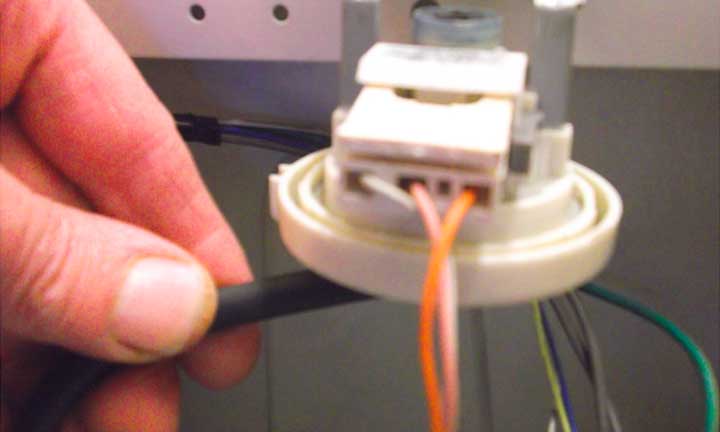 To do this, attach a small hose, approximately 10 cm long, to the inlet fitting and blow into it. Hold the unit to your ear and listen for a click when the pressure sensor on the self-resetting contacts is triggered. The number of clicks depends on the pressure switch version.
If this number is zero, the sensor is not working.
A more reliable way to check is to use an ohmmeter. It's connected to the connector on the unit. The meter will display readings that will differ when the circuit is closed or opened.
Each appliance has instructions that describe the procedure and include a diagram of the washing machine's pressure switch.
Setting up a washing machine pressure switch
The volume of water used during washing is adjusted using the water level switch. This is achieved using the central and peripheral adjustment screws.
Central screw needed to establish contact connections.
Peripheral controls their rupture.
Some washing machine models have more than one sensor. And the number of programs in a washing machine varies, requiring different amounts of water.
Take for example gentle and normal washThe difference in fluid volume is approximately half. Therefore, adjusting the alarm is a delicate matter and is usually performed at the factory by specially trained personnel. the position of the adjusting screws is usually fixed with varnish or paintIf the adjustment is incorrect, the entire washing program may be disrupted. Therefore, it is difficult to independently adjust and determine how much water the machine will require for a particular wash cycle.
Replacing the pressure switch
When diagnostics I discovered a faulty water level sensor and it needs to be replaced with a new part. You can handle this yourself.
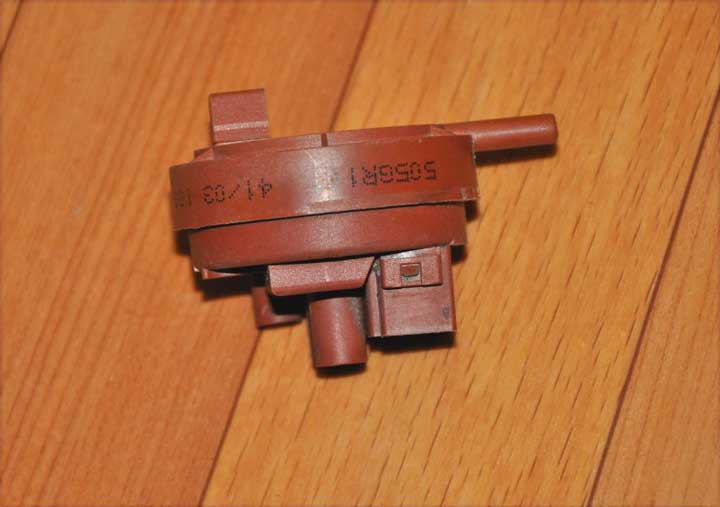 The part isn't expensive, and buying a pressure switch for a washing machine is no problem. Why isn't it repairable?
Because repairing a washing machine's pressure switch is a pointless undertaking. When disassembling its housing, the internal components usually break.
Which sensor should I buy? Exactly the same. The same model, the same type and name, with the same characteristics, based on the capacity of the loading drum and the model of the machine.
Original parts are a sure fit, you don't have to worry about them, and they last much longer and are of better quality.
Before installation, it would be a good idea to check its functionality and, if everything is in order, install it in place of the old pressure switch.
After repair, the machine is tested in several washing modes.


